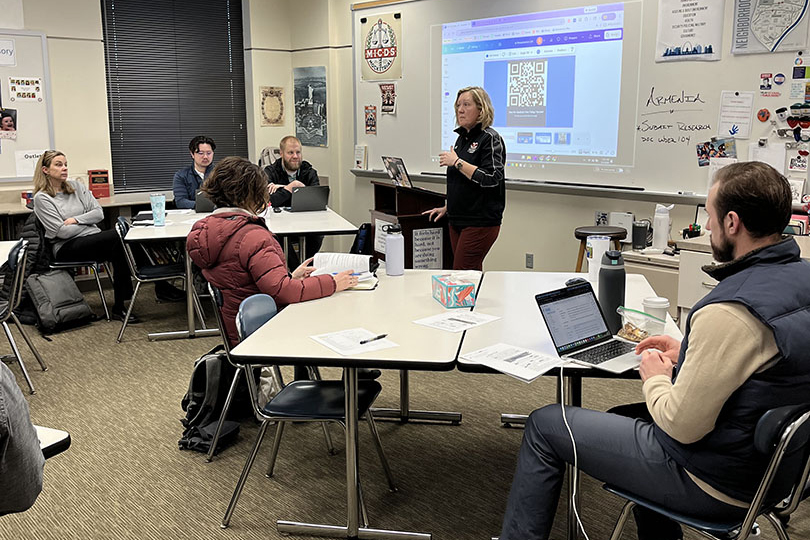
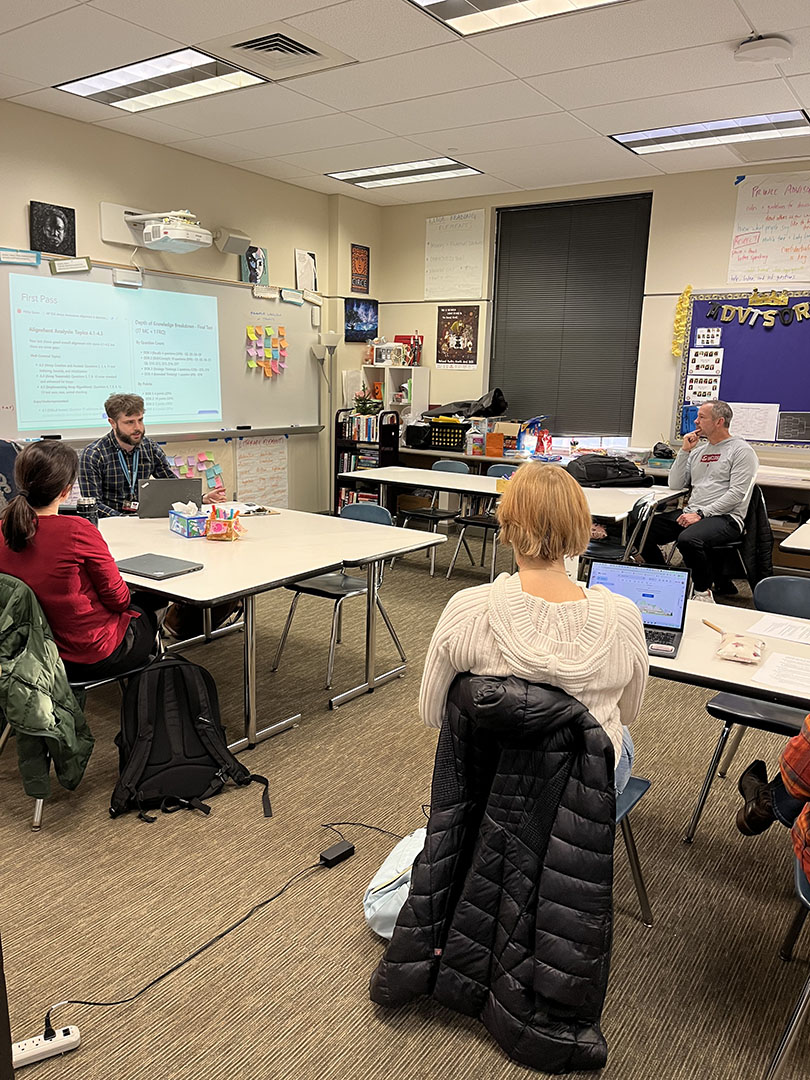
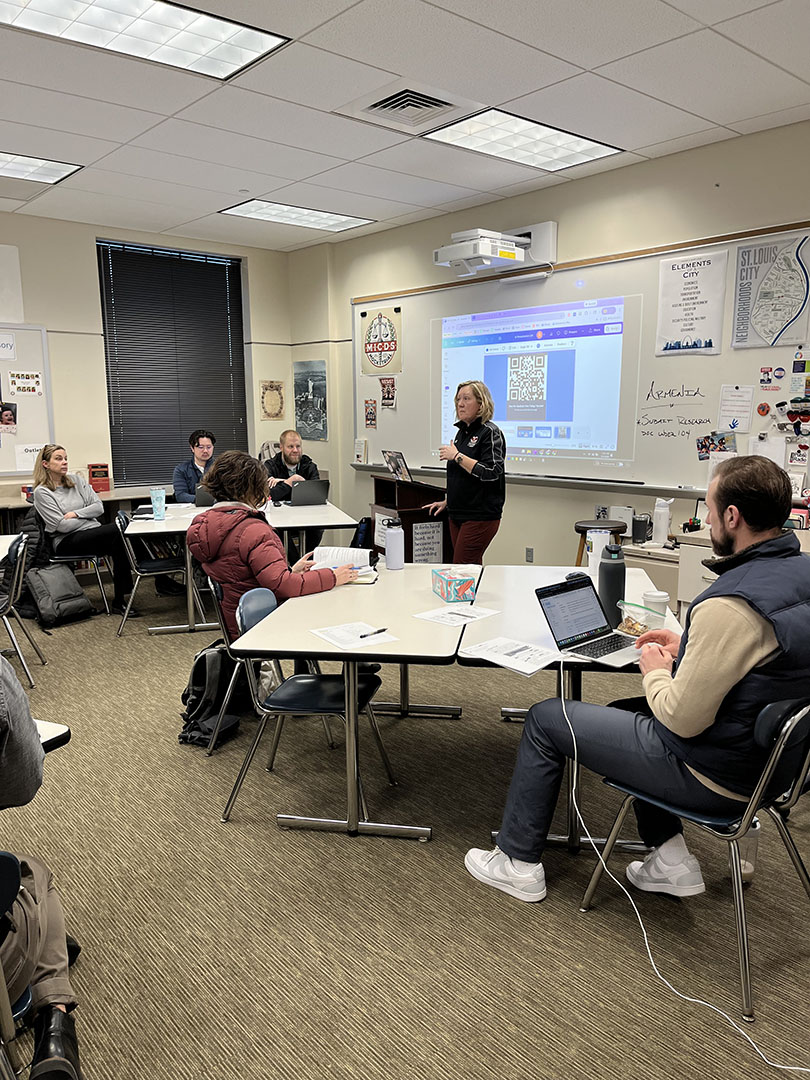
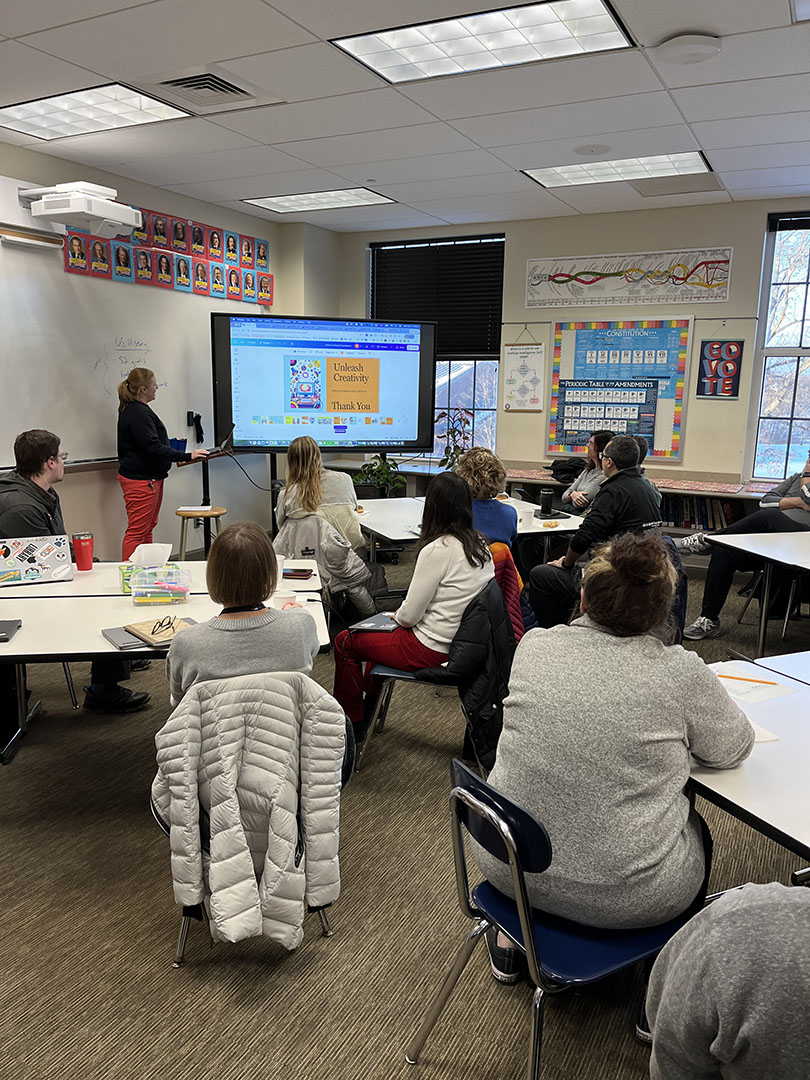
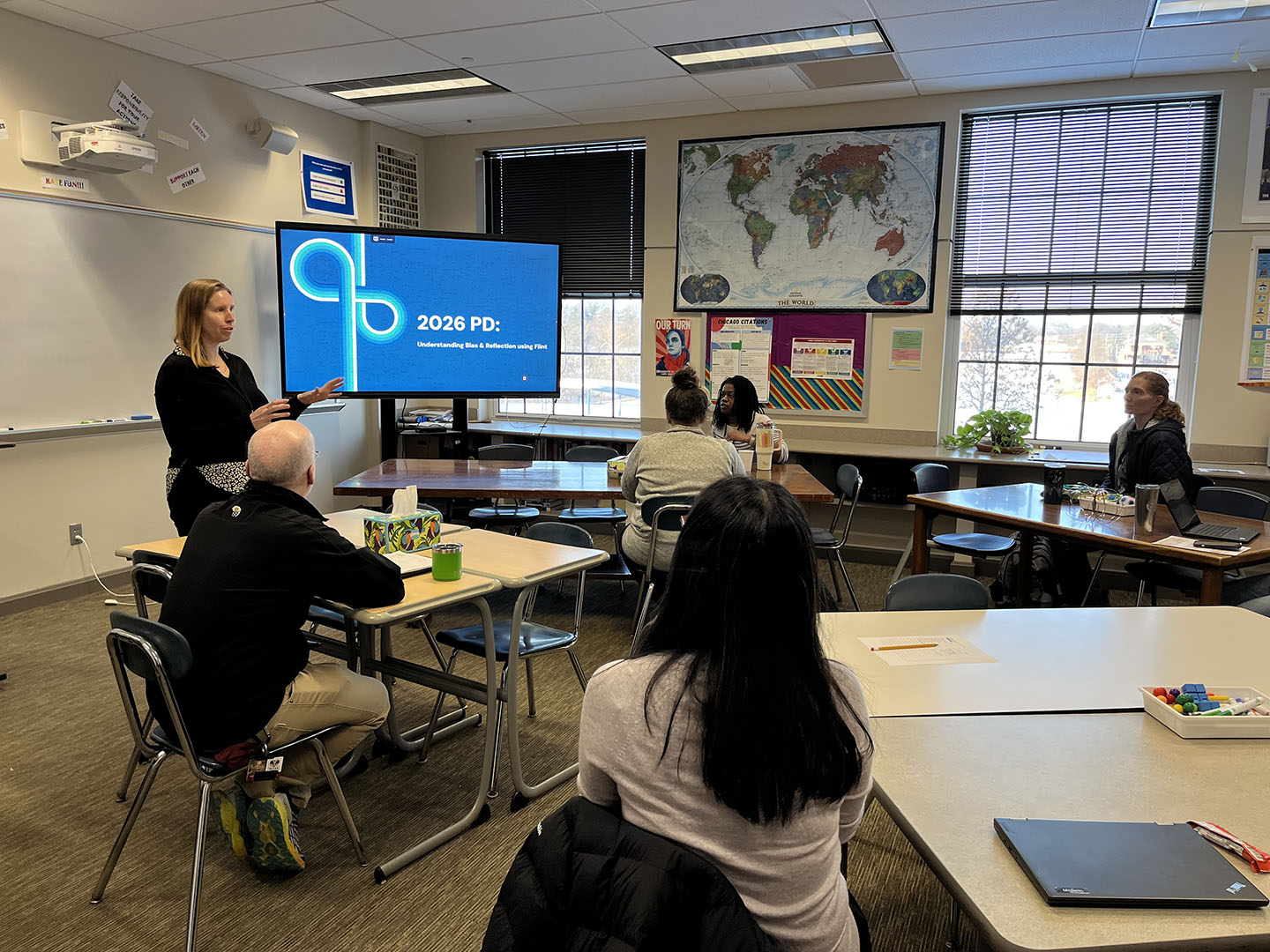
Wednesday, February 4, was a late start for all students, but that doesn’t mean people weren’t learning early! Our teachers once again became students and took full advantage of their peers’ expertise. This professional development session, sponsored by our academic department chairs, tackled a thorny subject: artificial intelligence (AI) in the classroom.
Diane Broberg, JK-12 Math and Computer Science Department Chair, explains, “In December, I attended the NAIS conference on AI and education. While there were many takeaways during the conference, there is one phrase that keeps playing over and over in my mind. One of the keynote speakers said, ‘AI is no longer a tool; it is a skill set.’ My response? ‘I’ve got a lot to learn for it to be a skill set for me.'” She told her peers that the session was a time for each teacher to add to their own toolkit with the goal of making AI a skill set they can then pass on to our students. “If it’s a must for us, then it’s really a must for them,” she said.
Ever resourceful, MICDS leveraged its outstanding internal resources and set up a robust program for teachers to help teachers. Each educator could choose two sessions to attend, and the topics were varied and appealing:
- Creating Visuals and Content with AI by Robyn Williams, Lower School Coordinator of Instructional Technology
- Administrative Writing Efficiency by Dr. Jody Marberry, Middle School Math Teacher, and Olivia Halverson, Middle School English Teacher
- The Art of Prompting by Tex Tourais, Dean of Digital Learning and Upper School English Teacher
- Lesson Material Creation by Laura Pupillo, Lower School Science Teacher
- Using AI to Evaluate Assessments by Phil Rosen, Upper School Math Teacher
- Building Rubrics Using AI by Brian Purlee, Upper School Maker & Robotics Coordinator and Science Teacher
- Understanding the Environmental Impact of AI by Paul Zahller, JK-12 Science and Engineering Department Chair
- AI Writing Voice by Jenn Sellenriek, Upper School English Teacher
- Show & Tell 1: How WE Use AI by Blake Whitney, Middle School History Teacher, Cameron Youngman, Middle School Math Teacher, and Dustin Delfin, Middle School Math Teacher
- Show & Tell 2: How WE Use AI by Dr. Tanya Roth, Upper School History Teacher, Kelly Weidenmiller, Upper School World Languages and Culture Teacher, Dr. Nick Miller, Middle and Upper School English Teacher, and Stephanie Matteson, Upper School Science Teacher
- How to Build a Flint Activity by Lily Childs, Upper School World Languages and Cultures Teacher, and Patrick Huewe, JK-12 World Languages and Cultures Department Chair
- Bias in AI by Elizabeth Wells, Upper School History Teacher
- Art, Humanness, and Robots by Sarah Garner, Lower School Art Teacher
- Differentiated Instruction and SPARK by Broberg and Carol Dalton, Middle and Upper School World Languages and Cultures Teacher
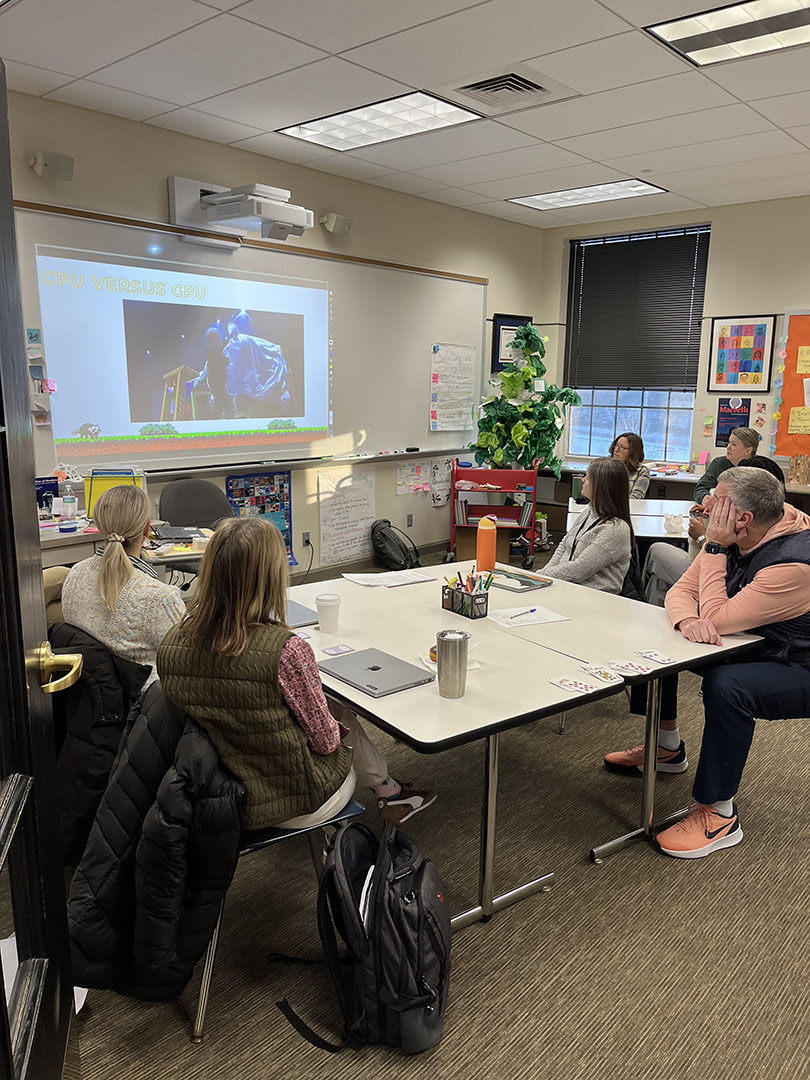
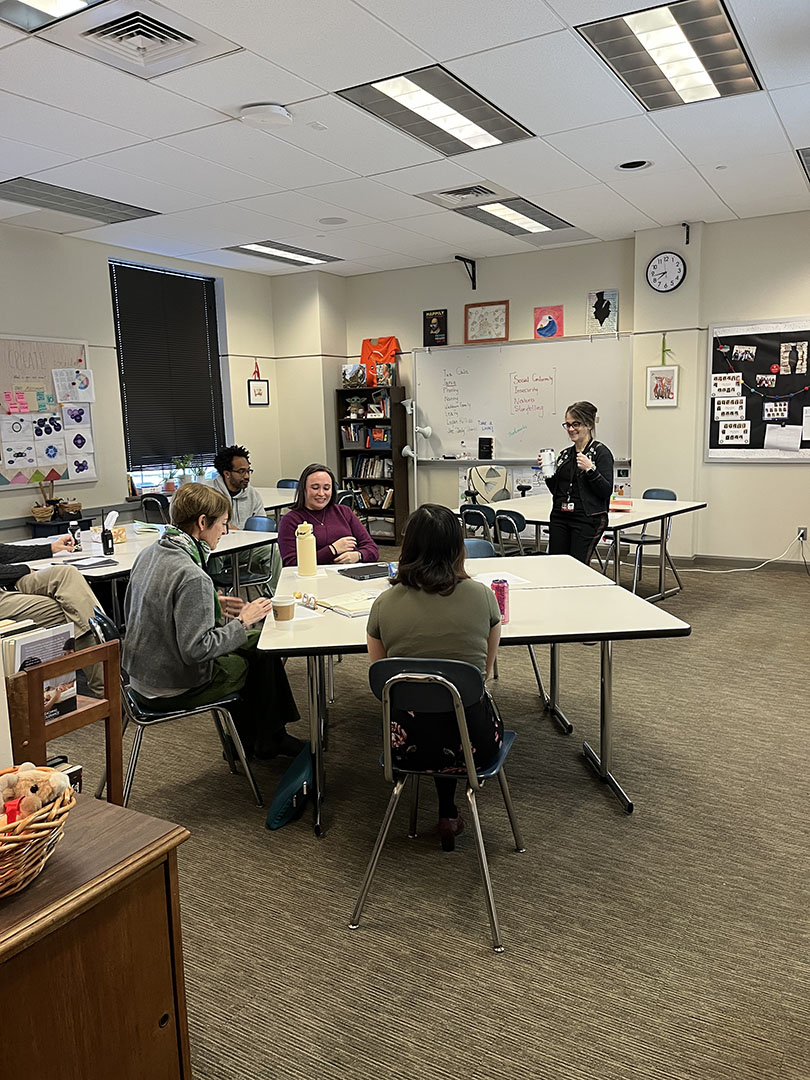
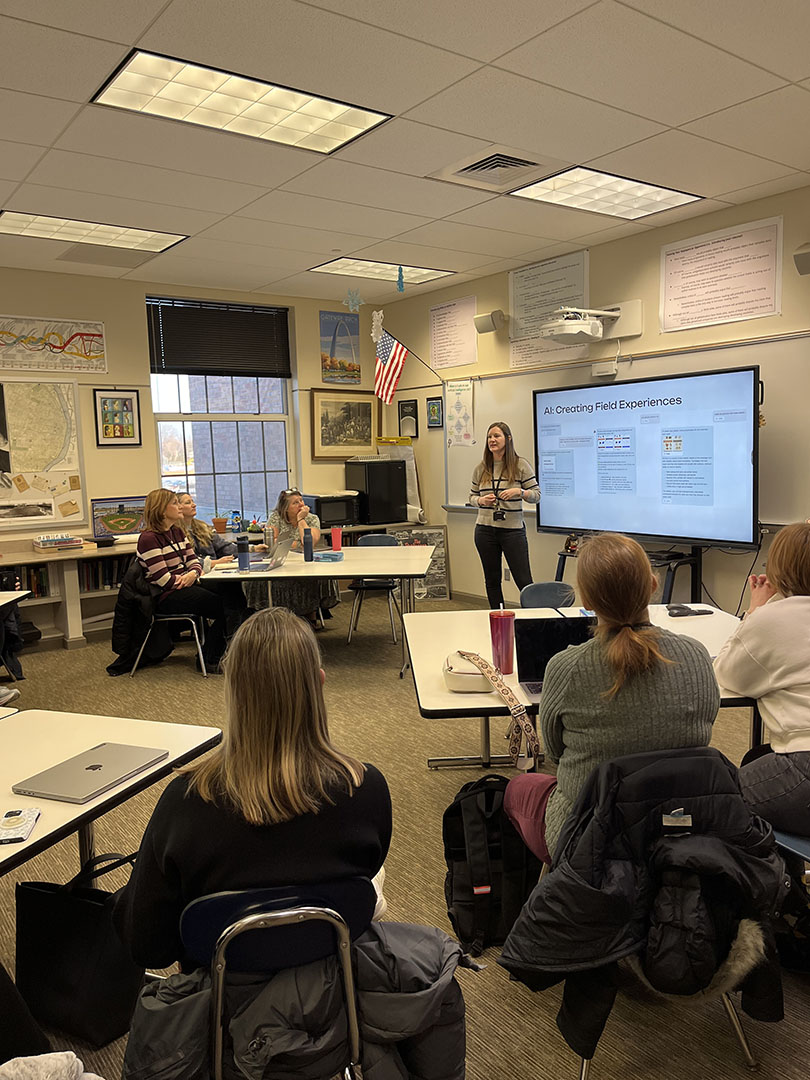
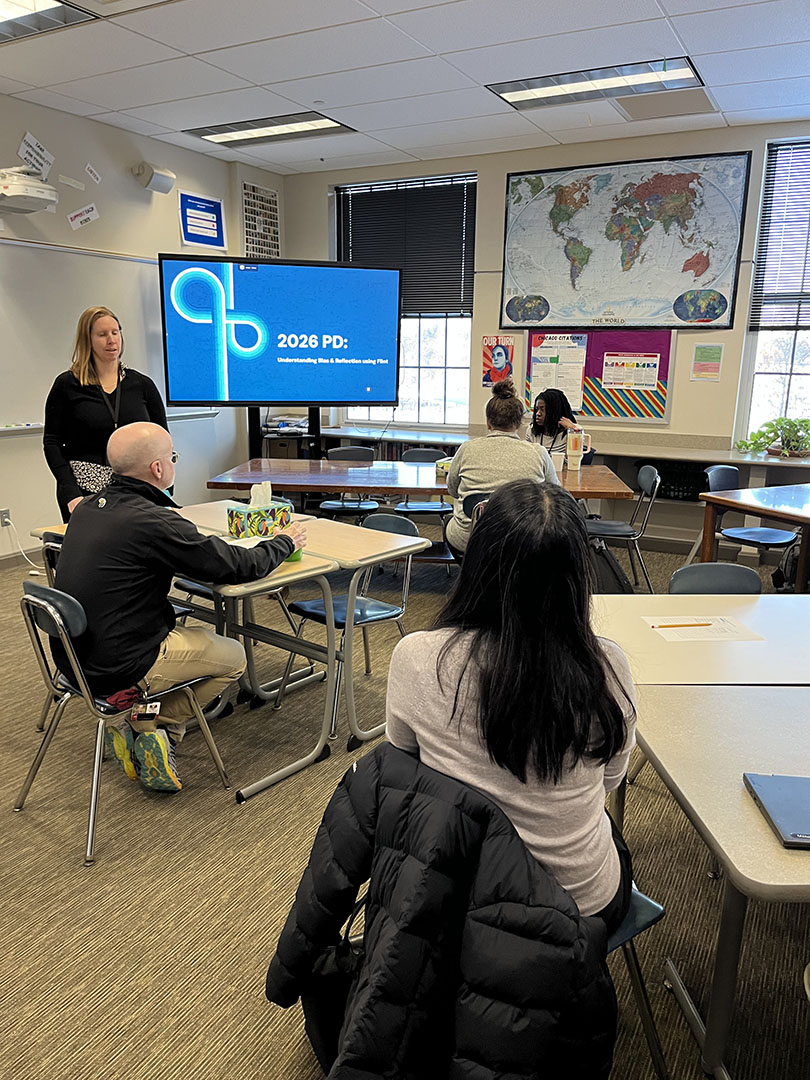
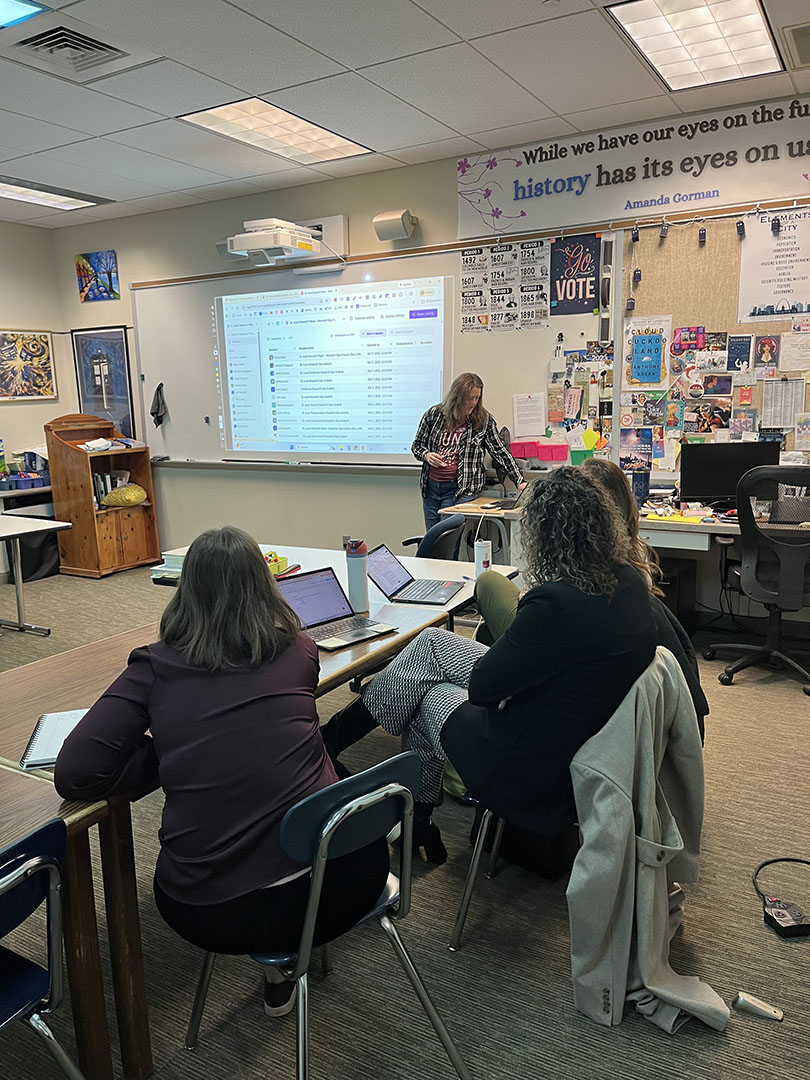
Garner’s session explored what art is, how AI creation has intersected with human creation, and different opinions on the matter. “I shared ideas that JK artists explored when painting with a robot and how fourth graders explored AI when creating packaging design, and decided that their creations were better than the designs that AI came up with,” she said. “The conversation explored some of the ideas on the MICDS AI scope and sequence, including understanding how empathy is a uniquely human attribute (grades three and four) and understanding the difference between humans and machines (JK-second grade). We also explored the differing opinions about AI and art.”
Pupillo presented on how to use a Chatbot to improve lessons and units. She reports, “We explored Flint’s chat feature for creating content images, unit feedback, creating games, lesson creation using prompts, and creating graphic organizers. We also looked at examples of when an AI chatbot has gotten it wrong and how to fix errors with additional prompting. Participants logged into Flint at the end and got to try out a new idea.”
Williams said, “My presentation focused on using Canva’s AI tools to efficiently create content, presentations, images, videos, and more. Beyond using Canva as a time-saving one-stop shop, the goal was to spark classroom ideas while highlighting that AI can generate ideas quickly, but our expertise and judgment are essential for shaping and refining the final product to ensure accuracy.”
Halverson and Marberry presented on using AI to assist faculty and staff with completing administrative tasks. “We investigated the platforms of Flint, NotebookLM, and ChatGPT, sharing how we’ve used all three for analytical and generative work,” said Halverson. “I found this topic relevant as I have used the various AI platforms as thought partners when writing parent emails, constructing progress reports, and managing large sets of student data and/or school data (such as the ISACS self-study reports for accreditation). It was invigorating to have several faculty come up to me afterward with huge smiles on their faces and share how they were able to overcome writer’s block for progress reports, set up a reflection activity for students, and so much more!”
Tourais presented on drafting better prompts. “I went over a few ground rules for what the goal of prompting is; then, I gave the faculty sample prompts built for specific administrative tasks and had them play around with those,” he explains. “We discussed what worked and why, and then I showed them how Flint could be used to develop a personal cookbook of prompt recipes for common tasks.”
Rosen presented on how he’s trying to use AI to help generate assessment questions and analyze assessment results. “The best possible version would let me create more comprehensive, creative, and better-designed assessments and more accurately adjust instruction to meet the needs of the students without sacrificing time for all the other things I need to do as a teacher,” he said. “I got the impression that many teachers have been working on similar processes, and it was great to share insights and think about ways we might improve the idea going forward.”
Zahller said, “In my session, I explored AI’s environmental impact, which is real but often misunderstood, by having faculty compare its energy and water use to other everyday activities to put it in context. The focus is on helping students examine scale, tradeoffs, and system-level solutions so they can make informed decisions in a world where AI is here to stay.”
This professional development opportunity was the first step in a four-part roadmap for AI integration and curriculum revision. The second step was for department chairs to gather feedback and reflection on the seminars. Later, they will work to synthesize feedback and process curriculum data. Finally, the chairs will define the revision process and schedule tasks for March and April. While the School currently has a full scope and sequence for the integration of AI, our teachers are always looking to refine and improve their pedagogical practices as they learn more and as systems evolve.
This first gathering was a resounding success! Here is what our teachers had to say:
Kelly Weidenmiller, Upper School Spanish Teacher, reports, “I participated in the Upper School Show & Tell and shared how I’m using AI in upper-level Spanish classes. I focused on how I’m using it to support preparation for writing and speaking assessments, literary analysis, and creative and analytical visual representations of authentic music that we study. This format was wonderful to be a part of because I find that seeing what other teachers are doing with AI is the most inspiring—it helps me to think outside of the box and consider things I never would have thought of on my own.”
Dr. Tanya Roth, Upper School History Teacher, said, “It was great. I went to Phil Rosen’s session on using AI to create/refine assessments, and it was so helpful to hear what has worked for him and what hasn’t, and to get his handout summarizing everything. I’ve done a little work around this, but it has inspired me to try a couple of new things that will lead to even more improved ‘best practices,’ I think. I was also on a panel for show-and-tell and came away with ideas I began immediately implementing to benefit my students, like streamlining the look and feel of my Canvas pages, as well as brainstorming new ways to approach assignments based on ideas I heard from one of my science colleagues.”
Callie Bambenek, Middle School Science Teacher, was effusive in her praise. “It really was a wonderfully reflective morning,” she said. “February can be a challenging month in teaching for a variety of reasons. Being surrounded by teachers who are thoughtful, reflective, and excellent at what they do provides me with a sense of ease and possibility. One of our department chairs even shared that she still has much to learn in order for AI to become a true skill set for her—and hearing that immediately refreshed my excitement. It was a great reminder that I, too, am always still learning. Engaging in this professional development with colleagues I trust and learn from made the experience feel both empowering and reassuring. It allowed me to lean into a professional challenge I genuinely crave and left me feeling re-energized and inspired as we move into the second semester of teaching our students. I’m really hoping for this type of professional development again.”
Lynn Mittler, JK-12 English and Language Arts Department Chair, spoke on behalf of the department chairs. “We are grateful to those who were willing to share with their colleagues,” she said. “It is a big risk to share your thoughts about something so new. Additionally, it was rewarding to be in a JK-12 environment so we can all realize that we are learning about this ever-evolving topic together. I was excited to get concrete skills and innovative ideas from all of the sessions I attended.”
Broberg notes, “It resonates with me and is why I presented and is why I continue to explore, experiment, and play with AI.” Our students are grateful, too, for teachers who continue to learn right alongside them!