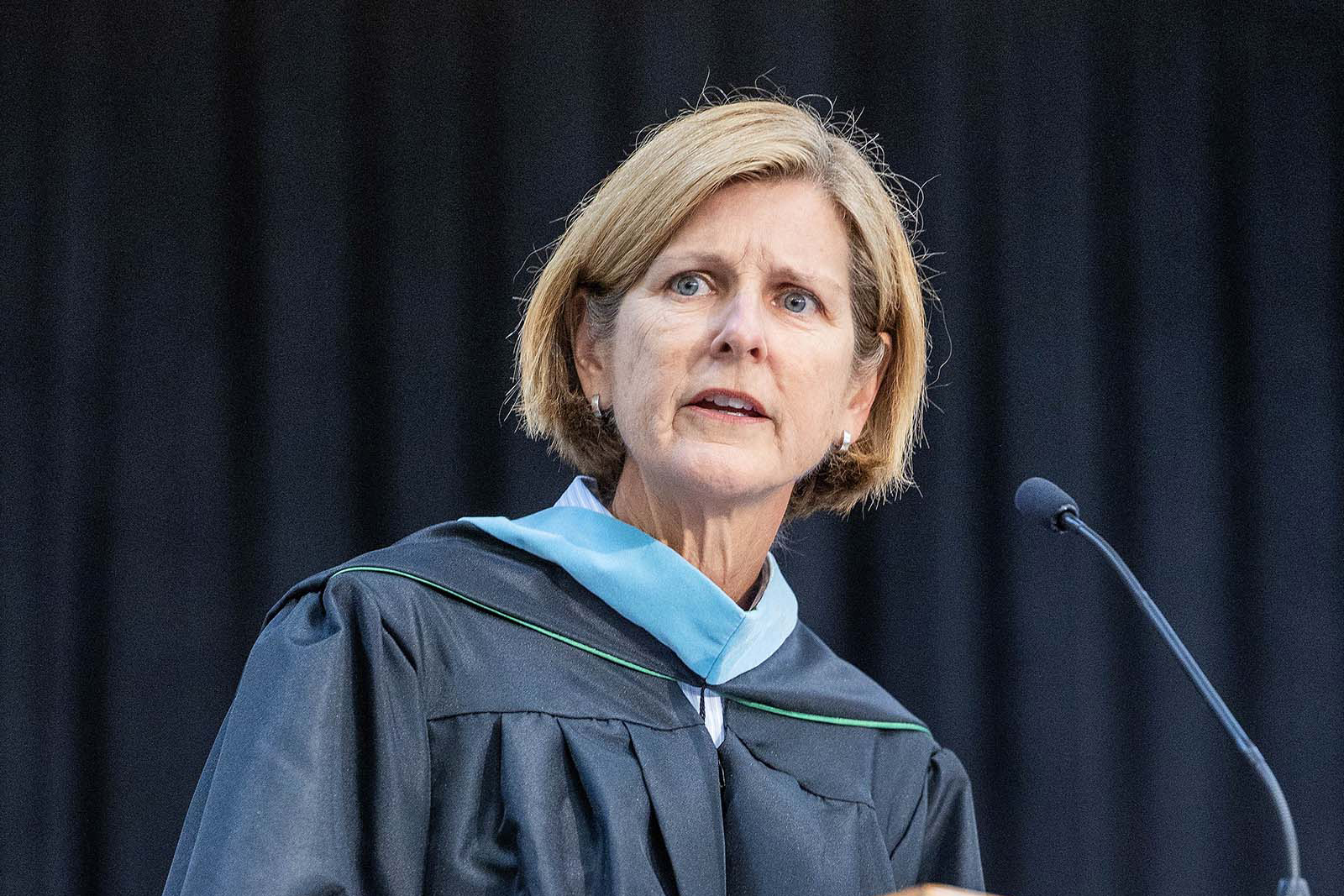
Lynn Mittler Addresses the Class of 2026 at Commencement
JK-12 English and Language Arts Department Chair and Upper School English Teacher Lynn Mittler was asked by the Class of 2026 to share her thoughts at their Commencement on Monday, May 18. Here’s what she said:
Mr. Rainey, members of the board of trustees, colleagues, family and friends of the graduates and most importantly, the Class of 2026. I want to thank you for the honor of addressing you this evening but more importantly, for letting me be part of your life going forward as the answer to the password recovery question, “Who was your high school graduation speaker?”
I also want to compliment you on your brave, or perhaps ill-considered, choice of inviting an English teacher to address you while you are a captive audience who cannot go out to the hallway to fill your water bottle.
With a practiced pause and stare, Mr. Nolan Clarke waited for our 22 intrepid South African travelers to quiet down from their milkshake- sugar high and calmly announced, “Be in the lobby at 4:30 AM. And don’t be late.”
I didn’t realize the purpose for our early departure until we were halfway up the side of Lion’s head mountain in Capetown. It was not to get a good start on the day or to beat the traffic on the trail, rather to get us to a point of no return before we realized that we were going to die.
As we climbed, I would periodically pause and look out at the beautiful vista of Capetown and the ocean below as the skies changed colors, careful to keep my gaze on the horizon and not glance at the edge of the path which would easily bring my demise.
To fight back my terror as we ascended what felt like a sheer cliff, I reminded myself that I had an image to uphold. I was not just a coach who urges her teams to push beyond their boundaries, regaling athletes with the idea that pushing oneself to the edge (no pun intended) of failure is where growth happens, but I also had a reputation as a fearless traveler who had lived in both West Africa and even Yemen during my time in the Peace Corps. There was really no way that I could communicate to the students how absolutely terrified I was for when we got to the mountain top, they were elated with the view, their accomplishment and the joy of being together in this absolutely magnificent place.
While I tried to distract myself by observing their smiles and very well-staged photos, I suddenly realized that this was not nearly over. We still had to go down and with that a constant view of every single precipice along the way reminding me of the possibility of plummeting to my death with each and every step. I will be honest, I really thought I was going into cardiac arrest which was going to be a very bad look, a huge inconvenience to Mr. Clark, and probably tricky to get the helicopter to land on the top of the mountain to take me to safety, but I had trip insurance so I felt pretty good about that.
After catching my breath, I quietly walked up to the guides who were having coffee with their biscuits and said with a tremulous voice, “Can you help me?” They immediately offered me comfort, reassurance and eventually accompanied me on every step as I headed down the mountain. They never made me feel like there was anything wrong with my fear or my need for their help.
As we began our descent, the children tumbled down the path like a pile of puppies, or my mind, lemmings and I slowly made my way with these expert guides who did not note my fear, but affirmed my ability to overcome it for at least this moment. I took frequent deep breaths and thought I was going to have a second heart attack when the guides had us take a break halfway down the mountain, seemingly hanging off the side of a cliff to hand out sunscreen and water. “Keep moving please!!!” I begged. “No one here is thirsty.”
When I got to the bottom of the mountain and throughout the rest of the day, I started checking in with the students about their experiences; many of them also shared that they had been scared, but they had surrounded themselves in the pack of their friends and their fellow travelers, and they had made it down together. I slowly shared with them that I had been afraid and remarkably, nothing happened. They didn’t look at me differently and our relationship didn’t change. I hadn’t lost respect in their eyes.
I want to be clear here. I am not advocating “what doesn’t kill you makes you stronger.” That motto was created by lion trackers and base jumpers. Just because you did it, because you went up and down that mountain when you were fearful of edges and heights, doesn’t mean that you won’t be afraid the next time you have to do it; it means that you will know that you’ve asked for help and you can ask again and that is a very important lesson.
Flashback decades, I don’t dare to tell you how many, I’m a Peace Corps volunteer standing in front of my class of 120 students, 110 men and 10 very brave women in a university lecture hall on the dusty high plains of a town called Dhamar in Yemen. I was thrilled about the lesson that day as we were tackling Robert Frost’s “A Road Not Taken.”
I read the poem to the giant hall and my voice reached a crescendo as I began the last stanza:
I shall be telling this with a sigh
Somewhere ages and ages hence:
Two roads diverged in a wood, and I—
I took the one less traveled by,
And that has made all the difference.
Standing there in my moment of “less traveled-ness,” I beamed at the class and asked with my brilliantly developed pedagogy, “What do you think?” Pause. The harsh sun came in the windows showing the dust in the air. More silence. I reassured myself that this is where “teacher wait time” comes in. Then to my relief, a tentative hand rose, “Doctora (I never corrected them when they called me this). Why did you have us read such a sad poem? Are all American poems this sad?” I panicked. This was my moment of triumph, my why for joining the Peace Corps. Had I not taught the vocabulary well enough? Did I read it too fast? What was the breakdown? I attempted to clarify the misunderstanding, “Why do you think it is sad, Ahmed?” “Quite simple, Doctora, why would you want to go on any journey without your family and friends?”
While I made that mistake at 23 years old, I know that you will not fall for this “fiercely independent” trope that society continues to perpetuate. You have learned over your many years here at MICDS, that it is in fact better to do things together, that community enriches our lives. I have watched you in 10th grade Spiderweb discussions gently try to help each other make meaning of a text, in GAP support your teammates during presentations in front of an alumni panel, in the aftermath of an overtime field hockey loss immediately comfort each other, in a state championship basketball victory celebrate four years of a journey together, in productions and concerts make magic on stage and even in your shared free periods build community and learn to value new individuals in your lives. And I’m gratified that you, the Class of 2026, will not have to wait until my age to learn how to ask for help as I have watched you reach out to teachers, directors, deans, coaches, advisors, and friends and come away stronger for it.
So often at graduations we assure you that you are prepared to enter the world bravely and go forth. You are. But you don’t need to do it alone. And while the tears you see in the eyes of those who love you today are filled with pride, they are also filled with sadness that our time of accompanying you has come to an end. And now, you will need to go out and build new communities, ask for help from those whom you have not even met yet, and support people who will start out as strangers to you. A Harvard research study of Adult Development that has been going on for 88 years (and you thought the ALT project was long!) states “Good relationships keep us happier and healthier. Period.” You have already learned that. You don’t need a Harvard study to remind you. You know that you do not need to climb that mountain alone.
Congratulations Class of 2026. The world is lucky to have you.