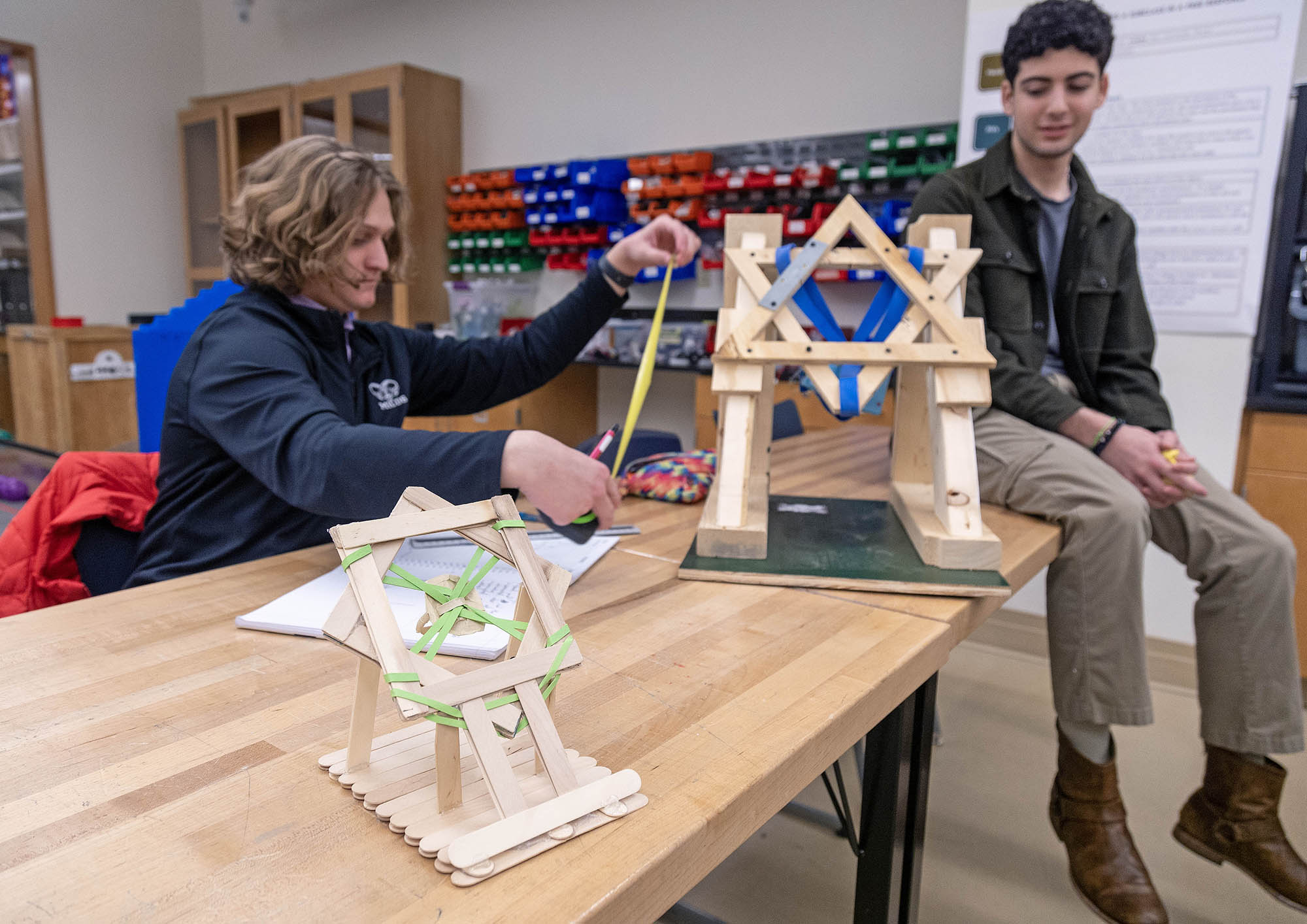
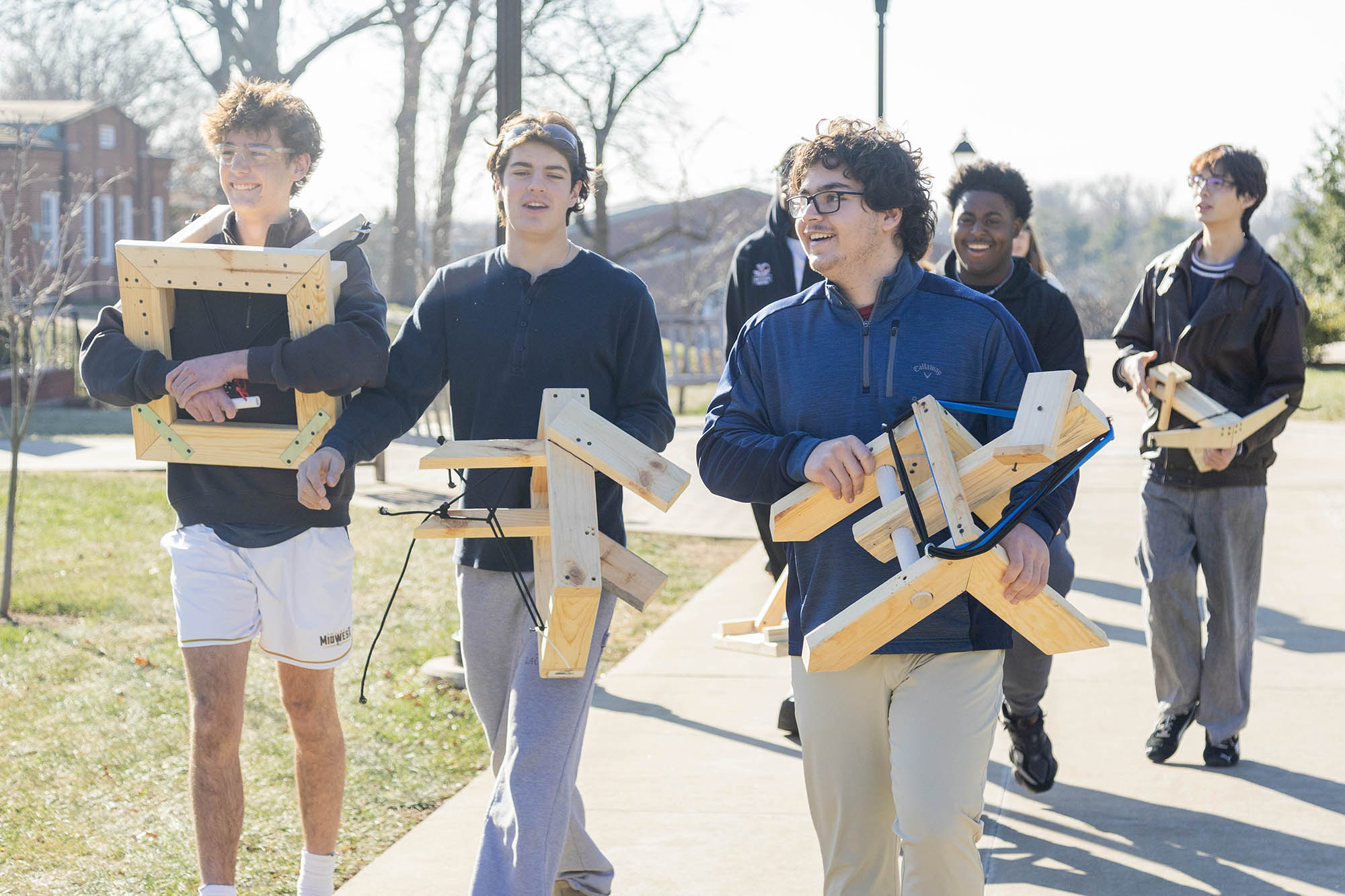
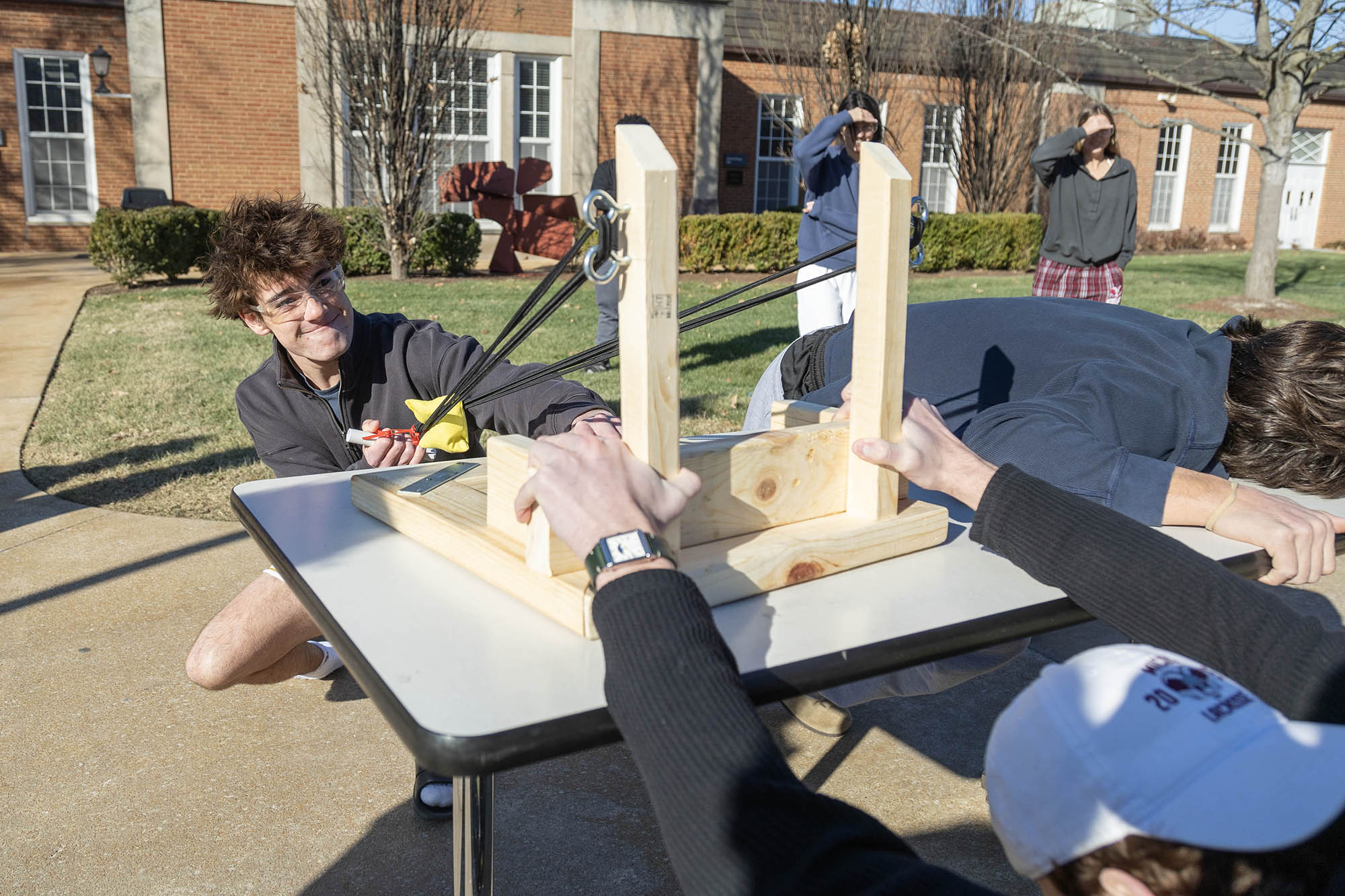
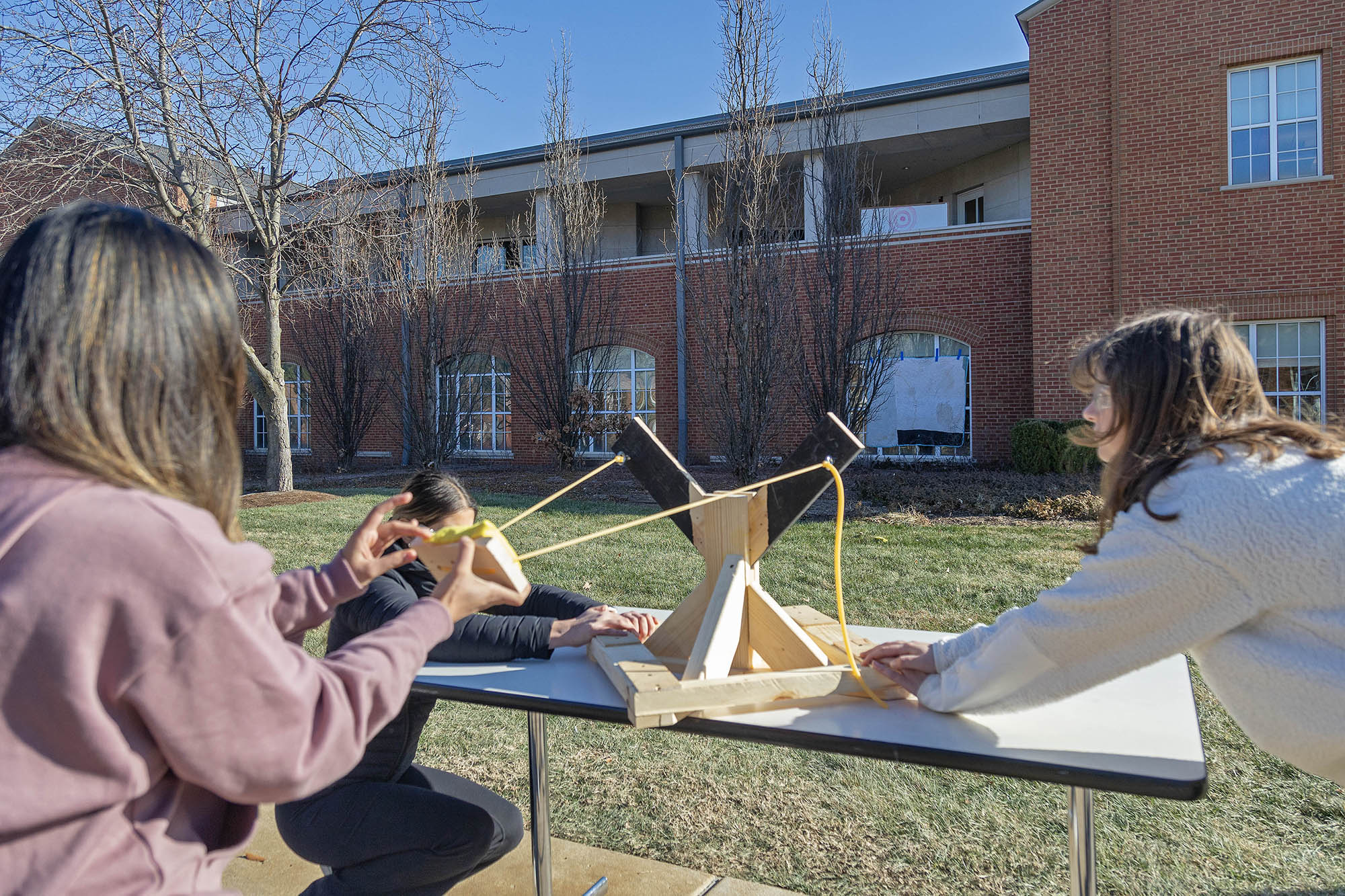
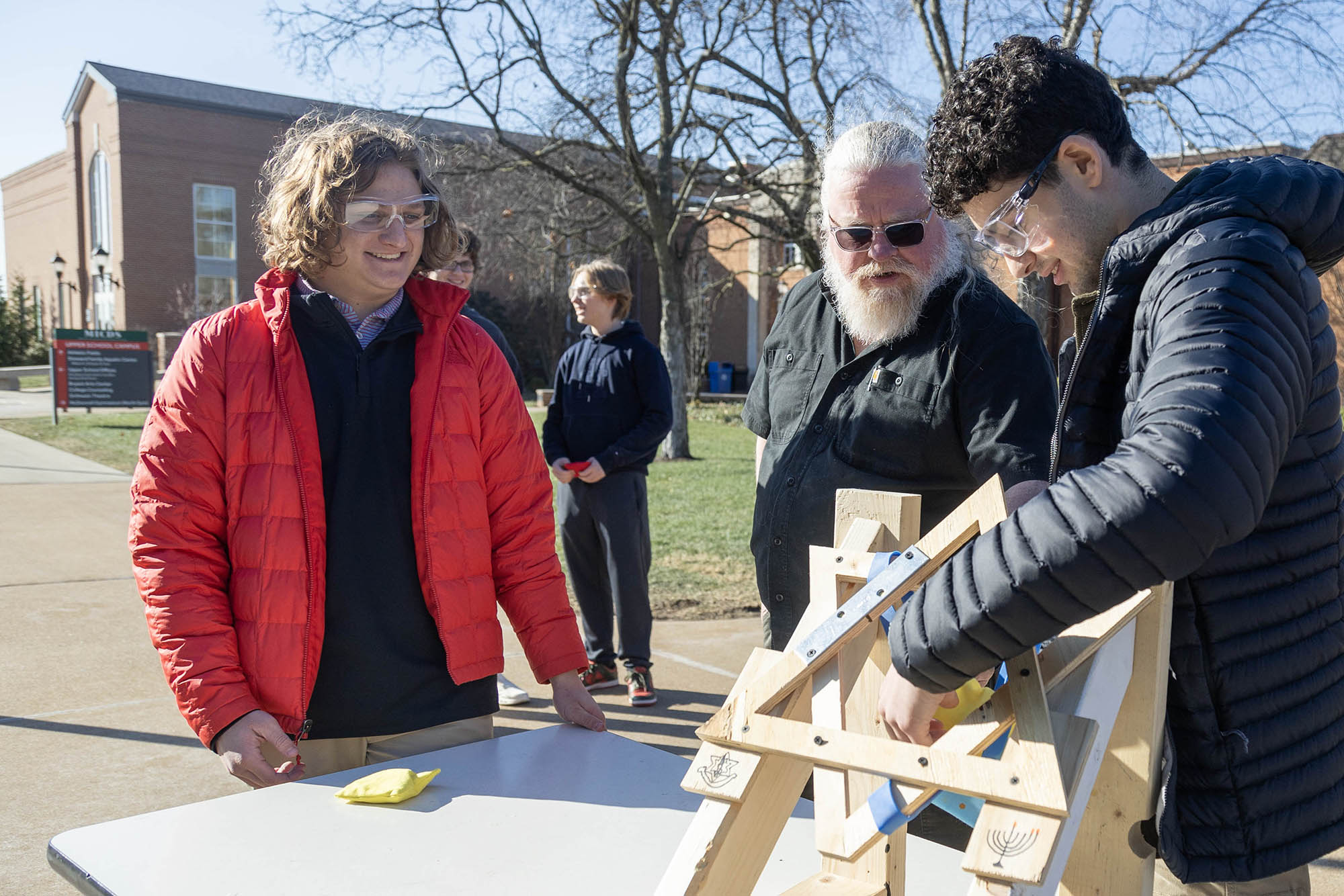
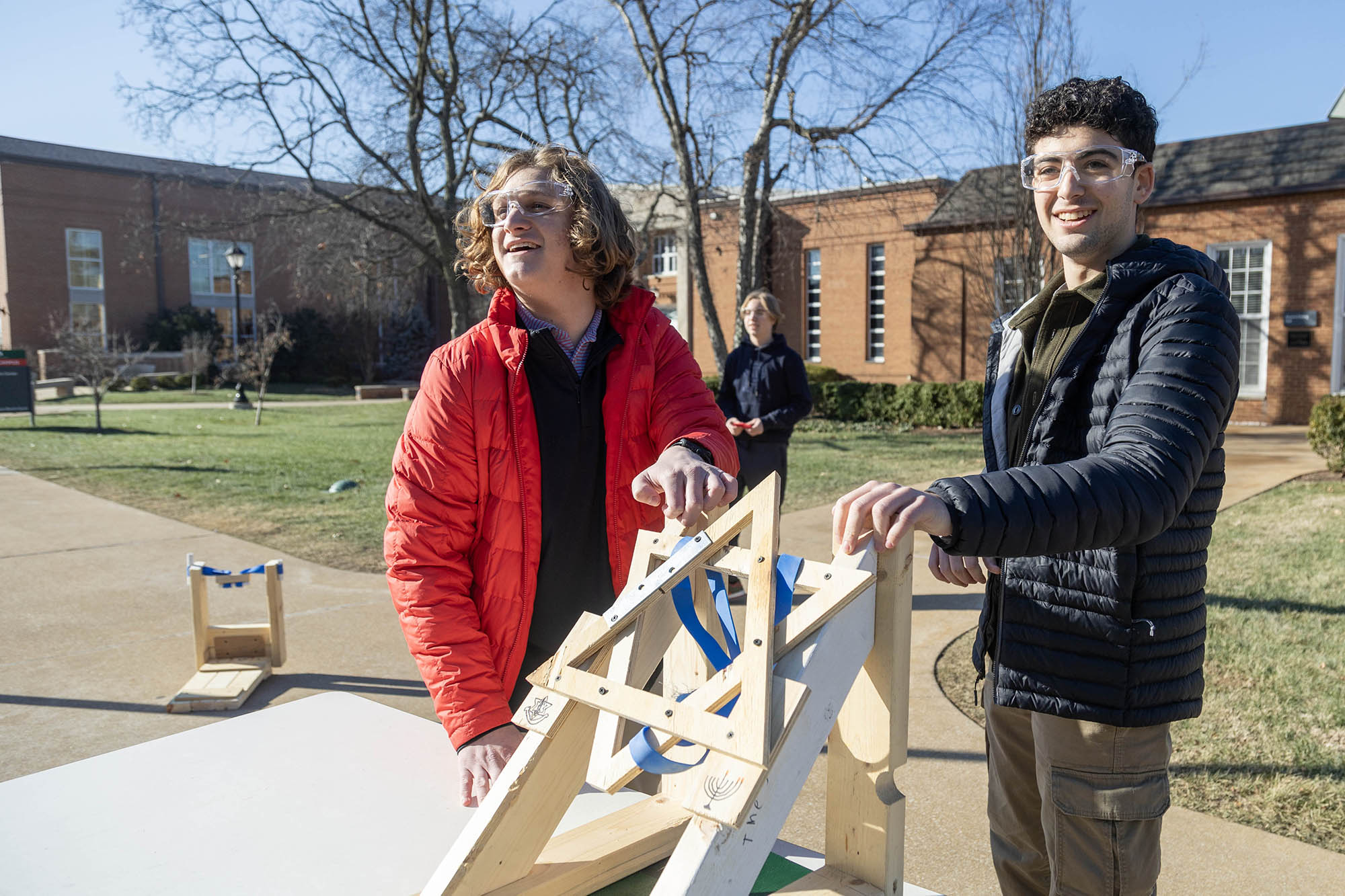
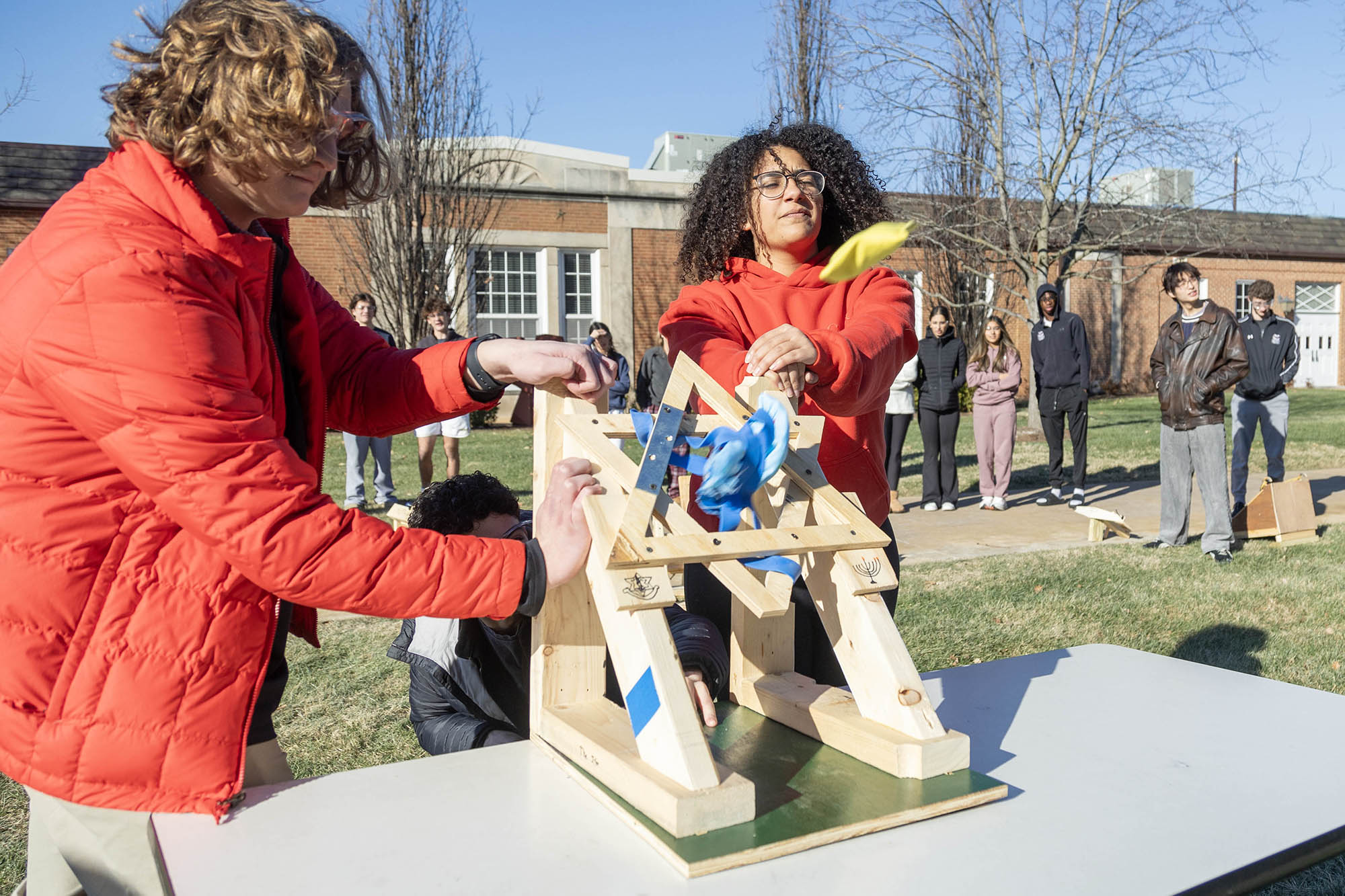
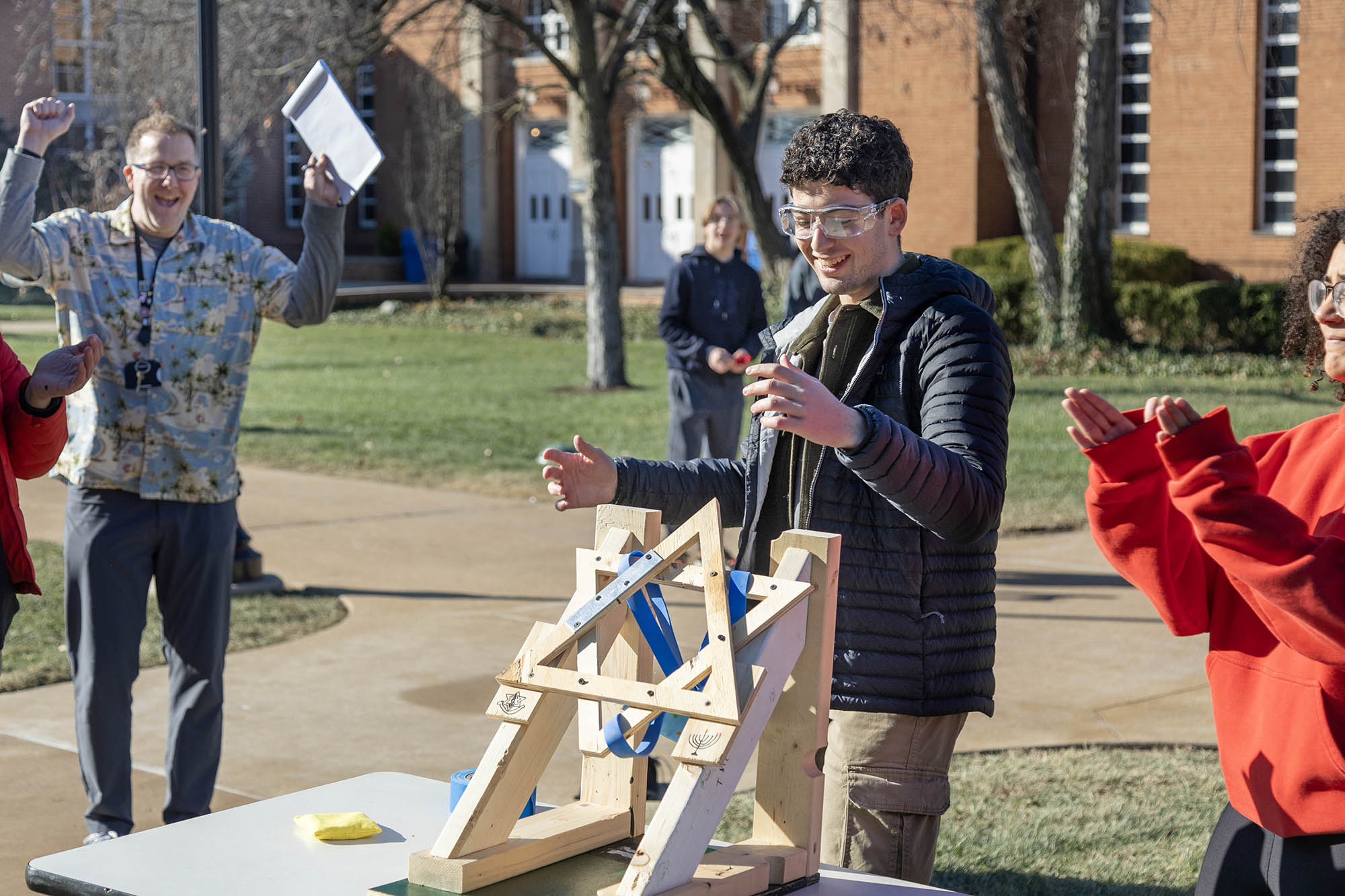
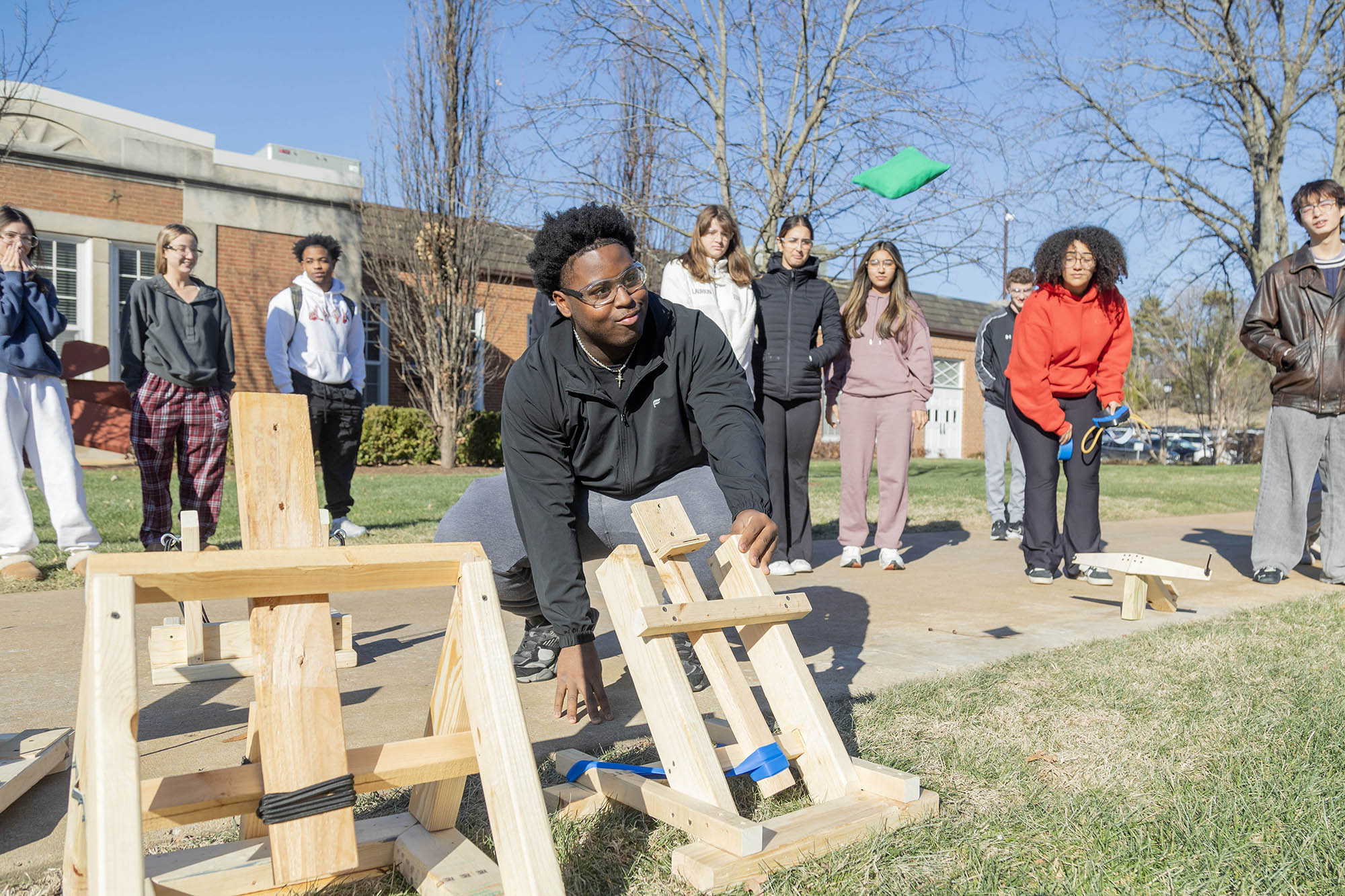
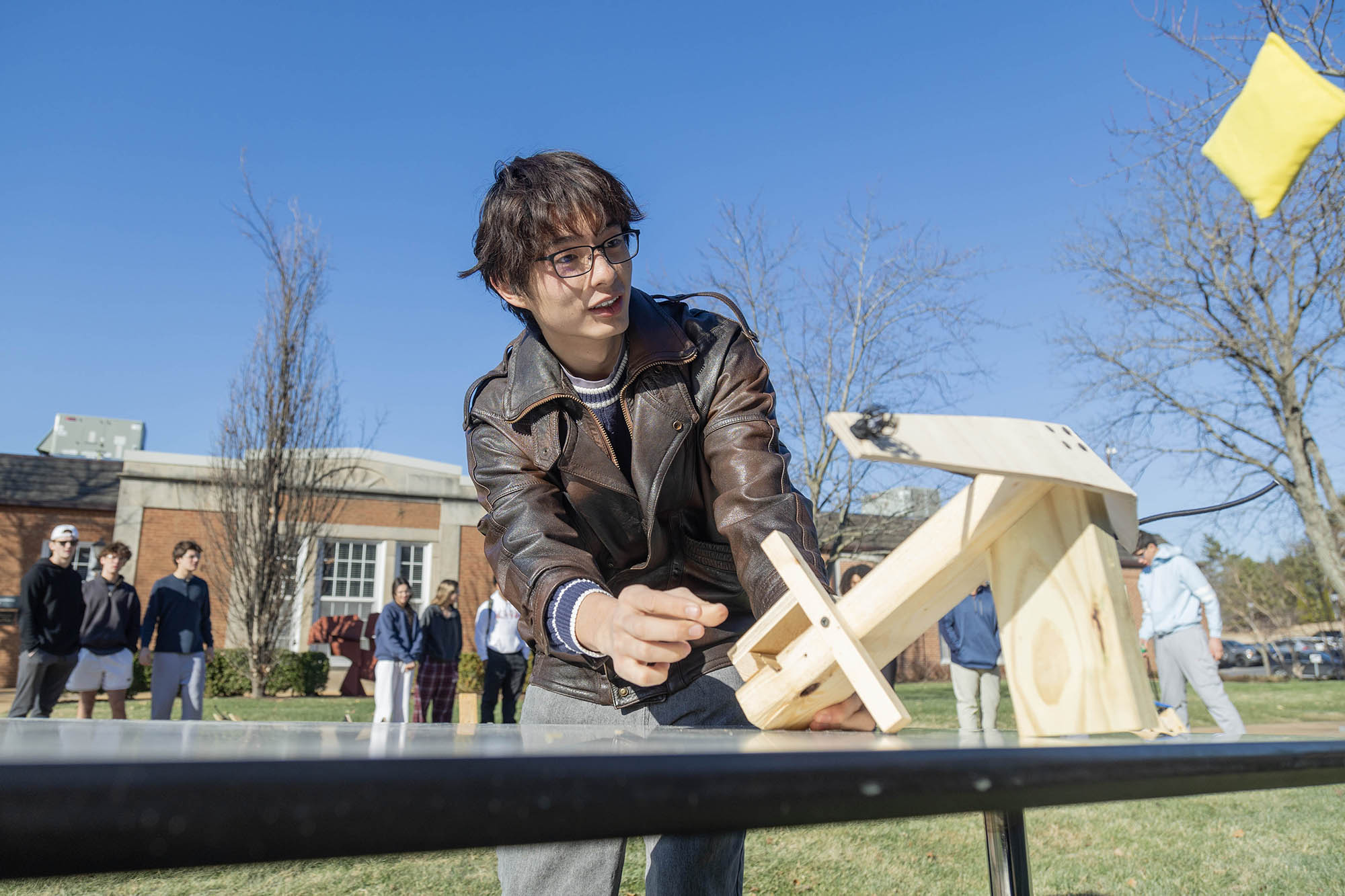
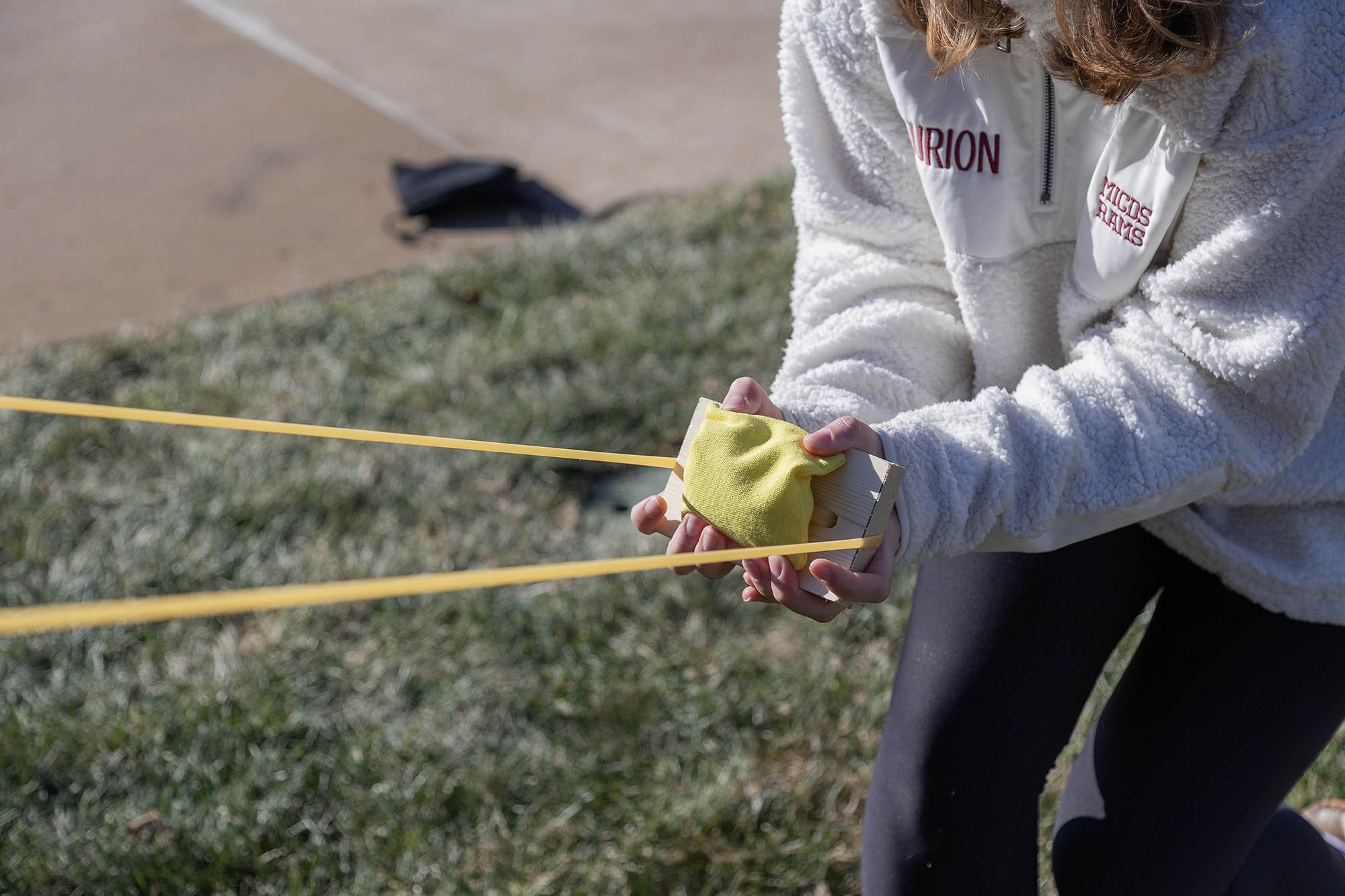
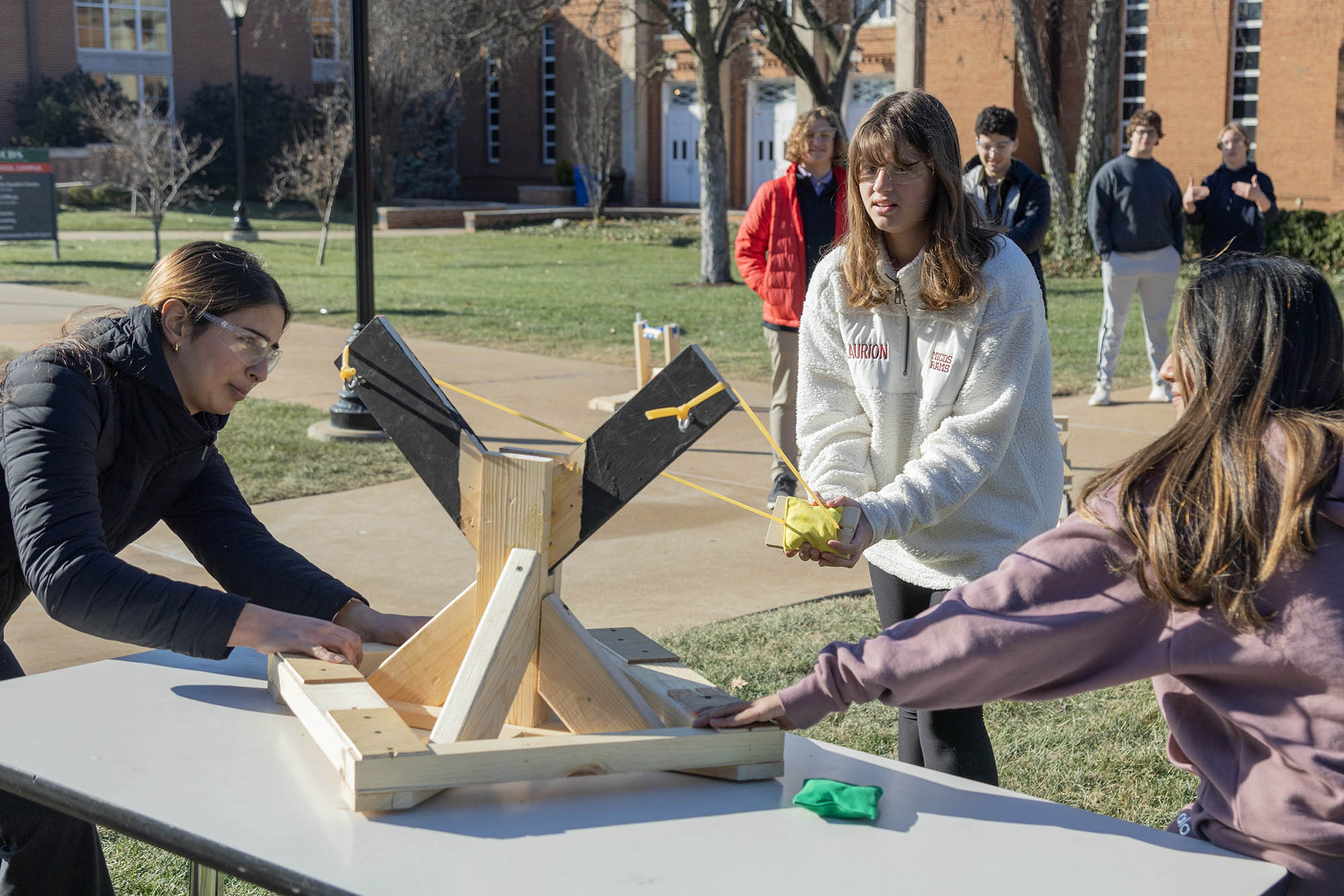
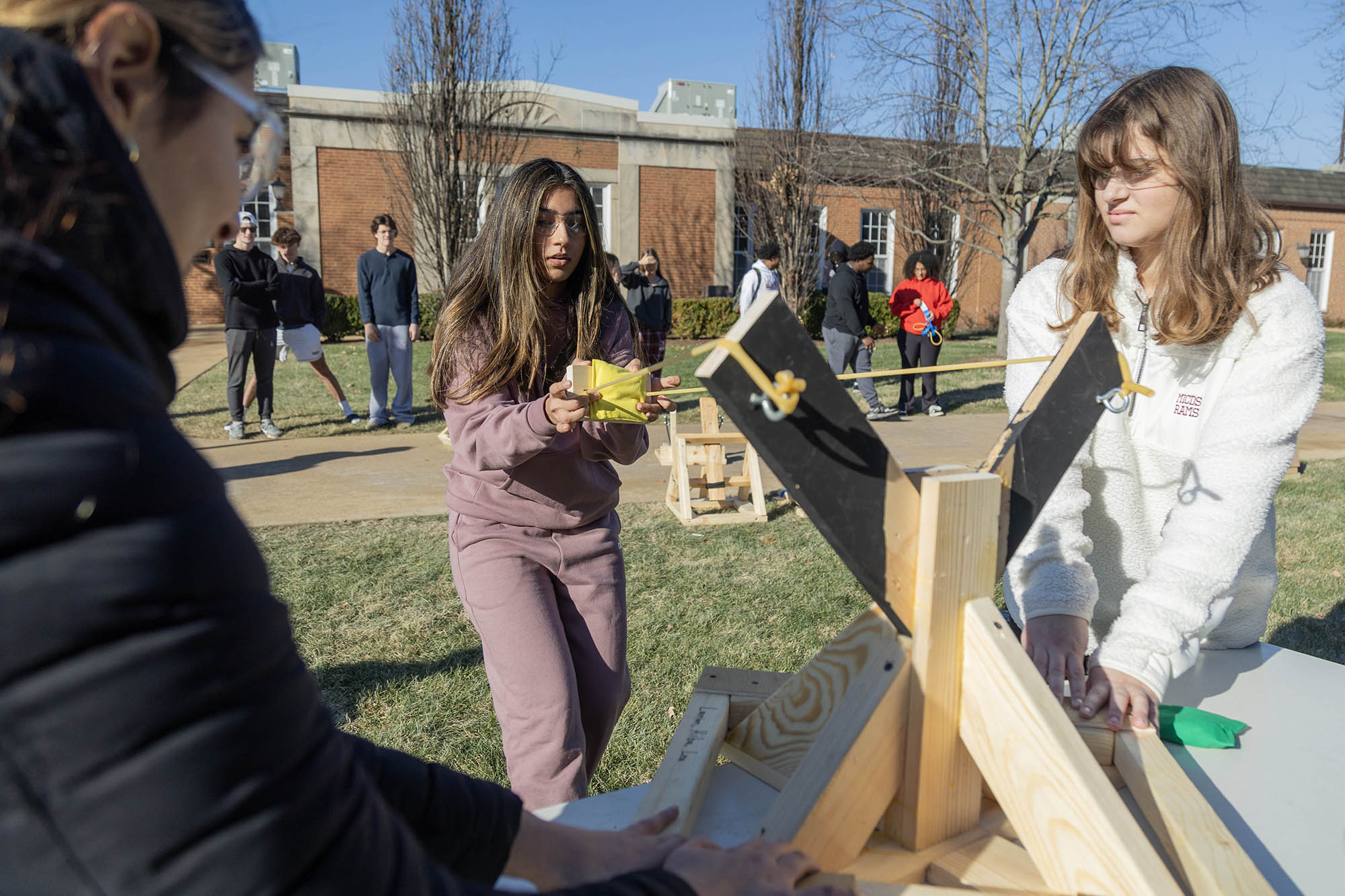
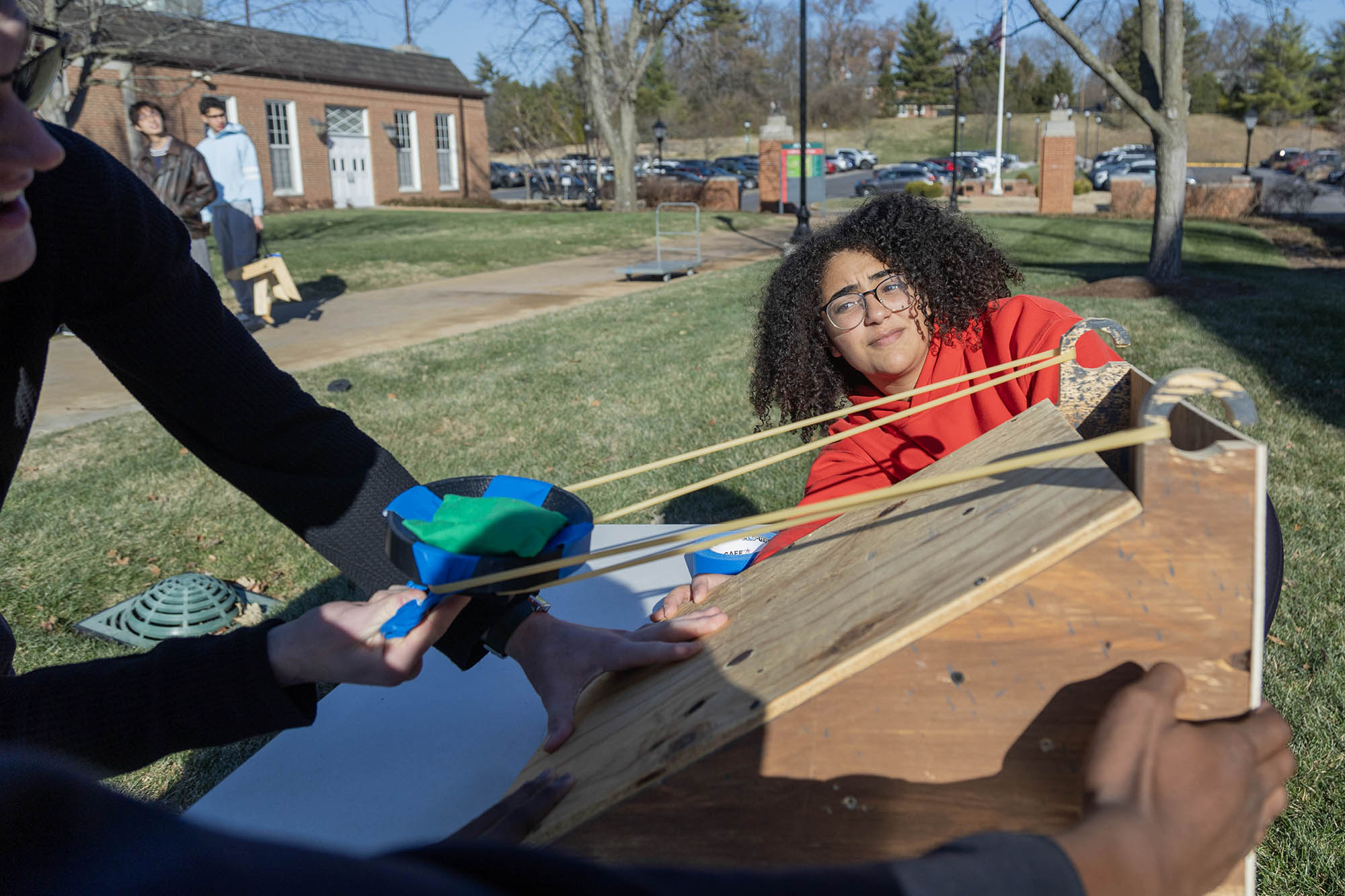
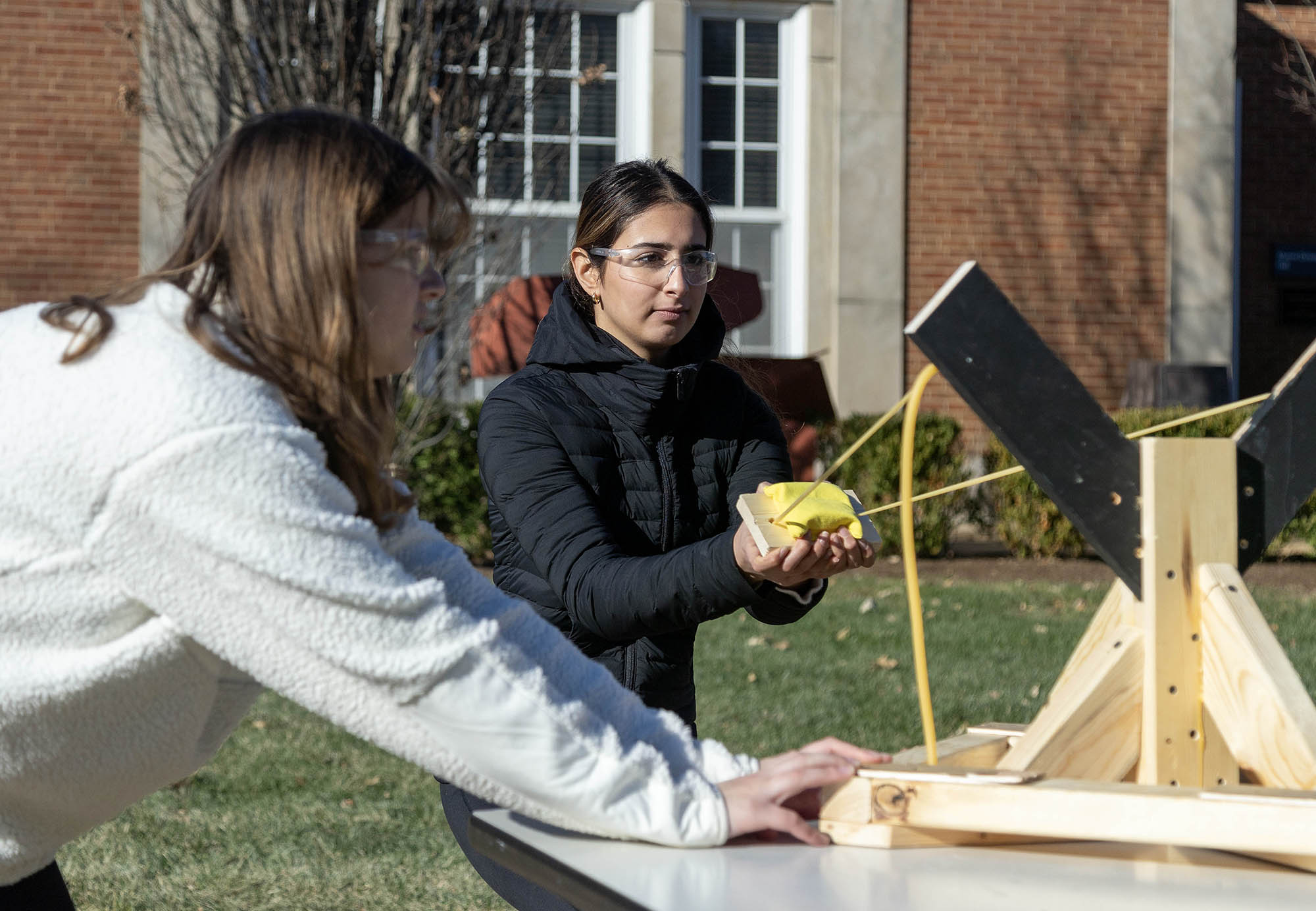
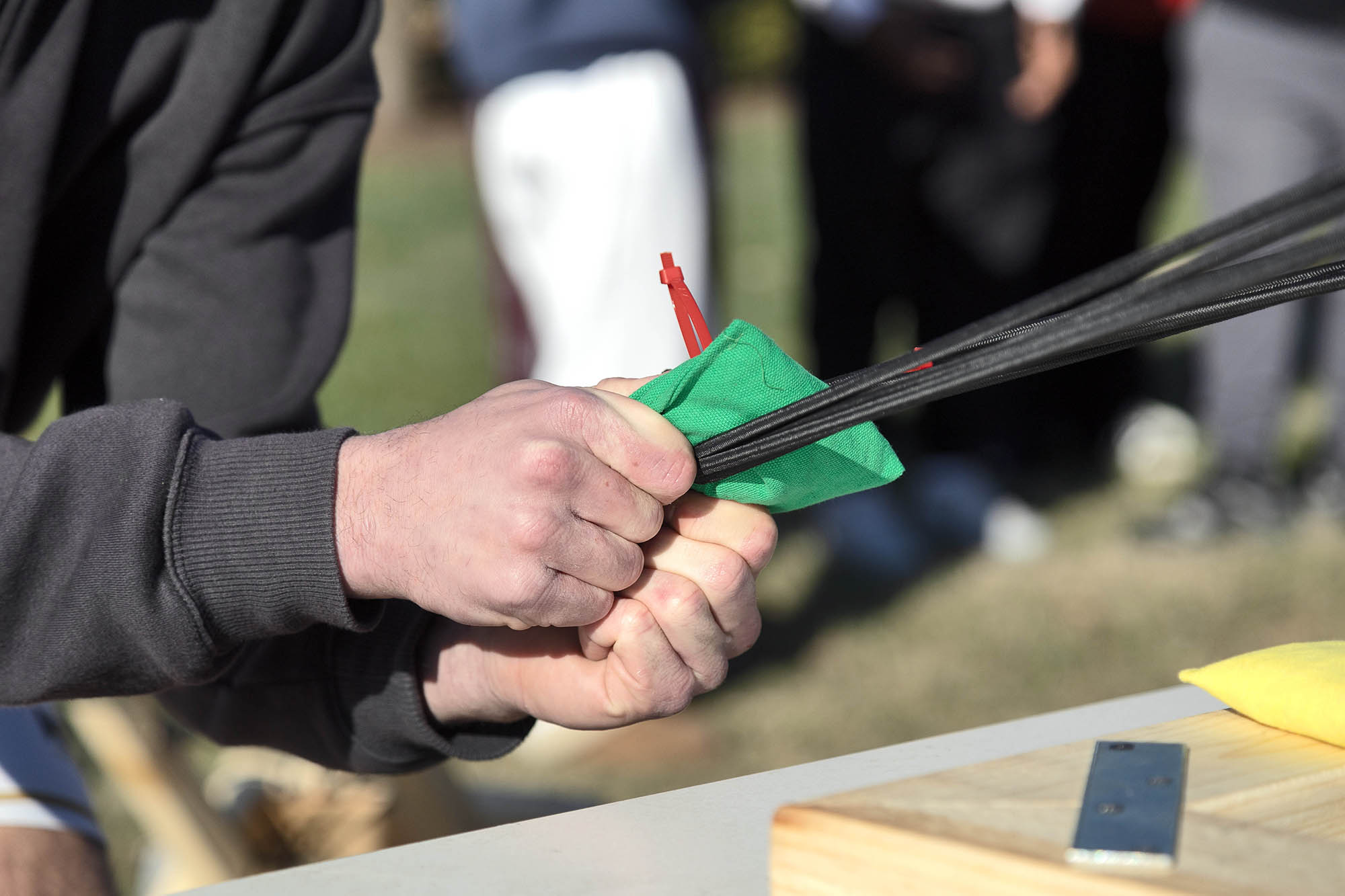
As the end of the semester approached, engineering students in Upper School Math and Science Teacher Mike Dorsey‘s class were tasked with designing and building a device capable of launching a bean bag. This was the culminating project of the projectile motion unit, in which they studied the basic components of projectile motion before designing, building, and testing a “fling machine” using basic materials like popsicle sticks and rubber bands. The junior and senior students then had to redesign their machines, scaling them up with the goal of launching a bean bag into the balcony of the STEM building.
The project engaged students on multiple fronts. “Projectile motion is a topic that combines concepts that students have seen in science and math classes before,” explained Dorsey. The design/build process required students to incorporate information from other classes while learning about building techniques and material science. Utilizing information from multiple disciplines certainly helped Gabriel Sedighi ’26 during the project. “This applied a lot of outside math and material knowledge,” he said. For instance, calculating the optimal launch angle of 45 degrees was easy for Sedighi and his partners because “all of us are in physics, so that actually helped a lot.” More than that, the entire project proved to be “a real-world application of all the stuff we always said ‘Oh, this will never matter,’ but it actually matters in this case.”
The Biggs Family Makerspace is often where classroom knowledge intersects with real-world applications, and this time was no different. “I think students typically enjoy getting to create something physical,” Dorsey said. “That’s definitely one of the major goals for this class.” The makerspace is also where new skills can be learned. Before she and her partner had to build their large-scale bean bag thrower, Caitlin Kenkel ’26 admitted, “I didn’t know how to use a drill at all. So that was a really big learning curve.” Teaching students not just what to build, but how to build it, is a team effort. “We could not have been so successful with this project without the assistance and expertise of Brian Purlee, Upper School Maker and Robotics Coordinator & Science Teacher,” said Dorsey. ”It’s great when teachers are able to collaborate to help make a class project come to fruition.”
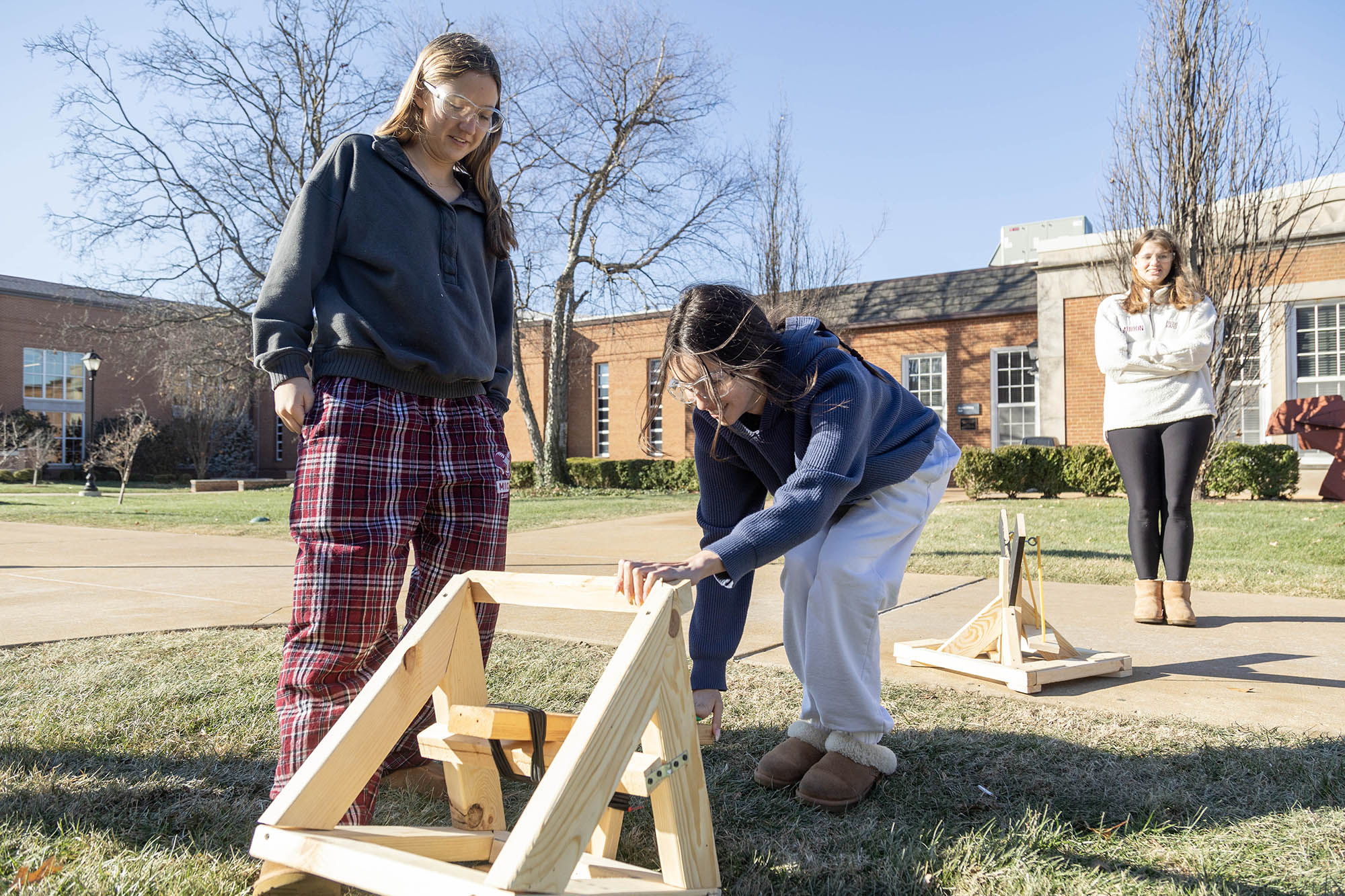
Designing and building the bean bag launchers might have been the whole project, but it was only half the lesson. In undertaking the project, “we’re trying to help students understand the iterative nature of engineering, and that it’s completely ok to fail,” explained Dorsey. “Several groups were disappointed in failures along the way and adjusted their designs and techniques.” Scaling the launchers up from the initial small-scale build proved challenging for several groups. “The biggest obstacle we had was accounting for the tension of the rubber bands,” said Luca Becker ’26. “On our smaller model, we featured a four-pointed star. Scaling up the rubber bands also scaled up the power, which scaled up the force needed to pull them back. So, we downsized our full-scale build to a six-pointed star rather than an eight-pointed star to account for that.”
Issues with the increased mass and the corresponding forces needed to make the larger launcher work were challenges Claire Kaiser ’26 also faced. “With the bigger materials comes bigger weight, and that made it a lot more difficult to actually work,” she said. As the size of the launcher increased, the constraints of some designs narrowed, and it became impossible to make. “That was our biggest challenge—on the larger scale, it’s harder to fix stuff once you’ve already made it,” she said. Kaiser’s partner Kenkel agreed, “We based our design on our small popsicle stick model, and it definitely worked better on that scale.”
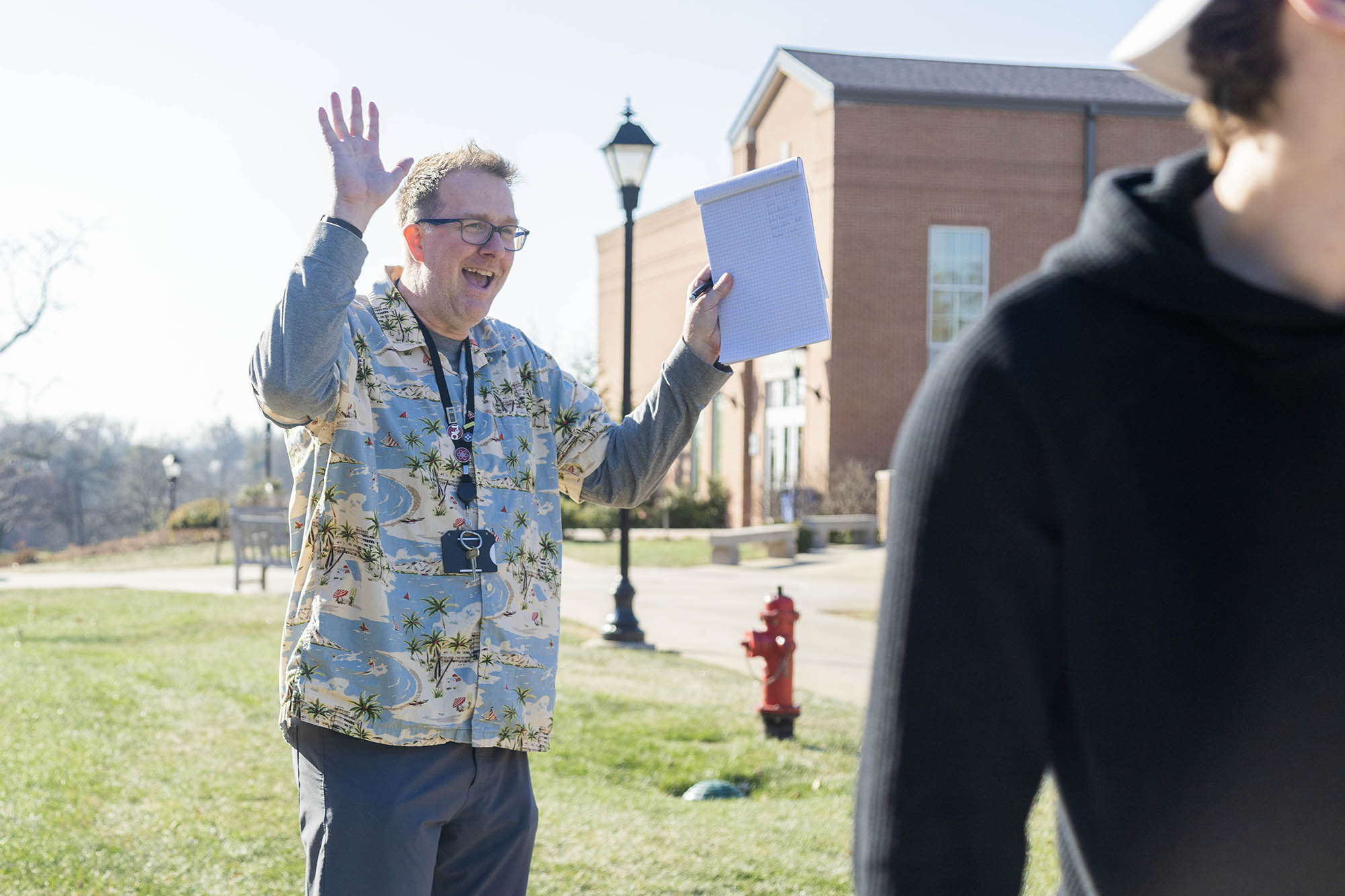
On launch day, “there were a lot of happy faces,” said Dorsey. He noticed how students embraced the engineering design process and made adjustments to their designs, usually resulting in a more successful shot. “I was very impressed.”