Story and photos by Gabriel Sedighi ’26
For more than 2,000 years, one thinker has quietly shaped how humanity understands truth, knowledge, justice, and reality itself. Born in the fifth century BCE, Plato of Athens wrote dialogues that continue to influence philosophy, politics, science, and ethics to this day. As philosopher Alfred Whitehead famously observed, much of Western philosophy can be understood as a series of footnotes to Plato. In MICDS’ Intro to Plato Winter Term course, students step back into ancient Greece to examine ideas that still resonate in the modern world.
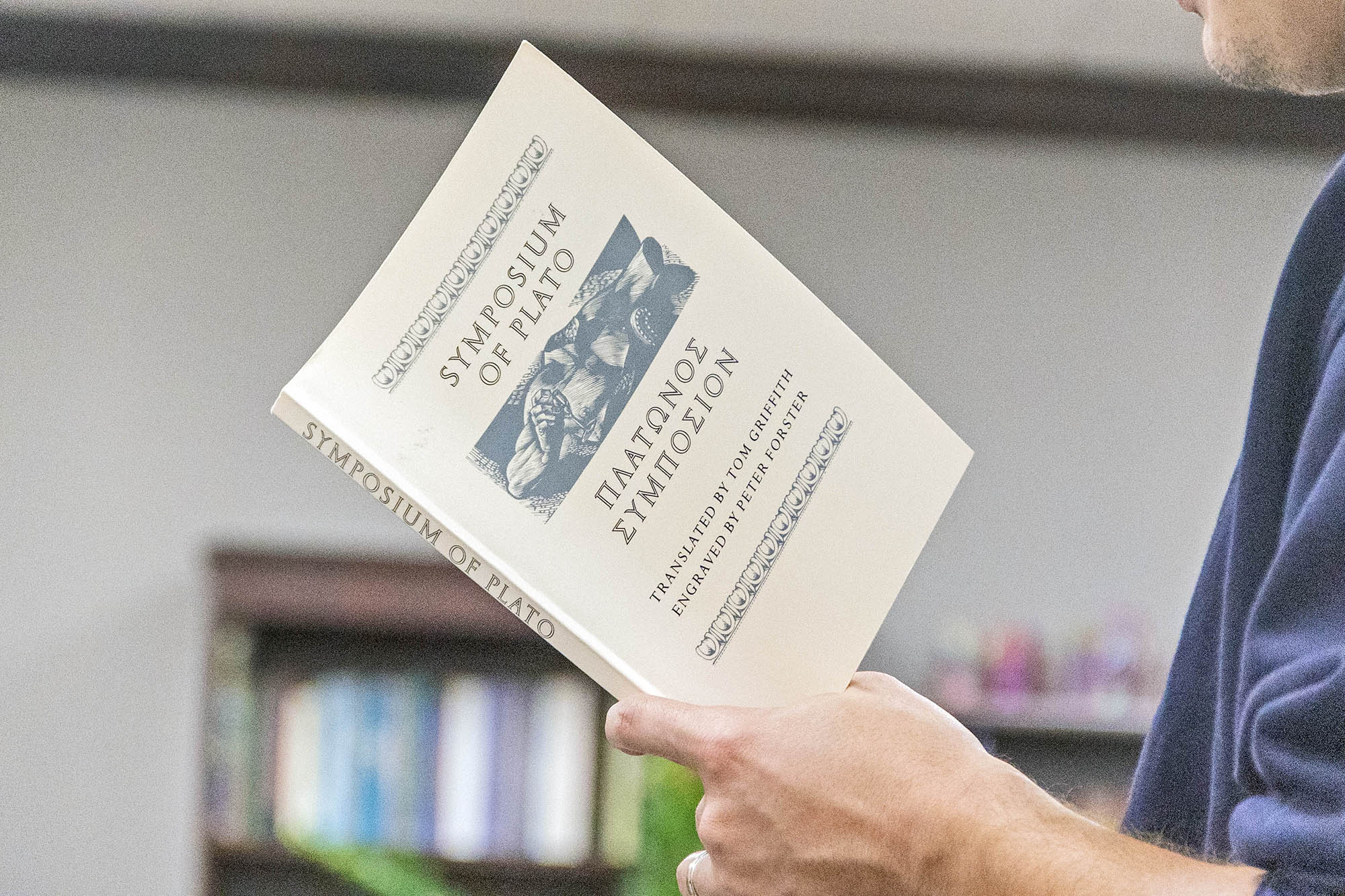
Taught by Upper School Classics Teacher David Armstrong, the course invites students to engage directly with Plato’s writings through translated dialogues, lively discussions, and close reading. Over the course of two weeks, students explore Plato’s evolving worldview, the questions he poses about reality and morality, and the critiques his ideas have faced across centuries. “Plato is sort of the foundational thinker in Western culture,” Mr. Armstrong explains. “It seemed like a good chance to spend two weeks reading some of his essential dialogues.” While the course does not attempt to cover every aspect of Platonism, it aims to introduce students to Plato’s method of inquiry. One grounded in conversation, debate, and intellectual humility.







Central to the class is Plato’s use of dialectic, a form of dialogue that encourages questioning rather than simple answers. To do this, Mr. Armstrong says that, “Plato charts a middle path between absolute relativism and absolute dogmatism. He has ideas and believes them, but he arrives at them through conversation rather than assertion.” This approach encourages students to think critically, articulate their perspectives, and challenge assumptions. Skills that extend far beyond philosophy.
Students have found the experience both intellectually stimulating and surprisingly entertaining. Eric Zhang ’27 shares that his interest in philosophy began at home. “My grandpa was very interested in philosophy, and he talks to me about it a lot,” he says. Reading Plato has only deepened that curiosity. “You would think that reading ancient literature would be boring, but it’s actually entertaining. Plato’s writings are pretty funny at times, too.” For Eric, the course has provided a clearer understanding of Plato’s ideas and their lasting significance. Others were drawn by a broader interest in the ancient world. Cella Held ’28 explains, “I’m interested in the Greeks and ancient mythology and philosophy. I want more knowledge about how we can use it in modern-day society.” One standout moment for her was reading Socrates’ Apology in which Socrates defends his beliefs without fear. “I found it really interesting how he isn’t afraid of death or to speak out for what he believes in,” she reflects.





By the end of the course, students leave with more than historical knowledge. They gain insight into why Plato remains essential reading and why, even today, nearly everyone is at least a little bit a Platonist.