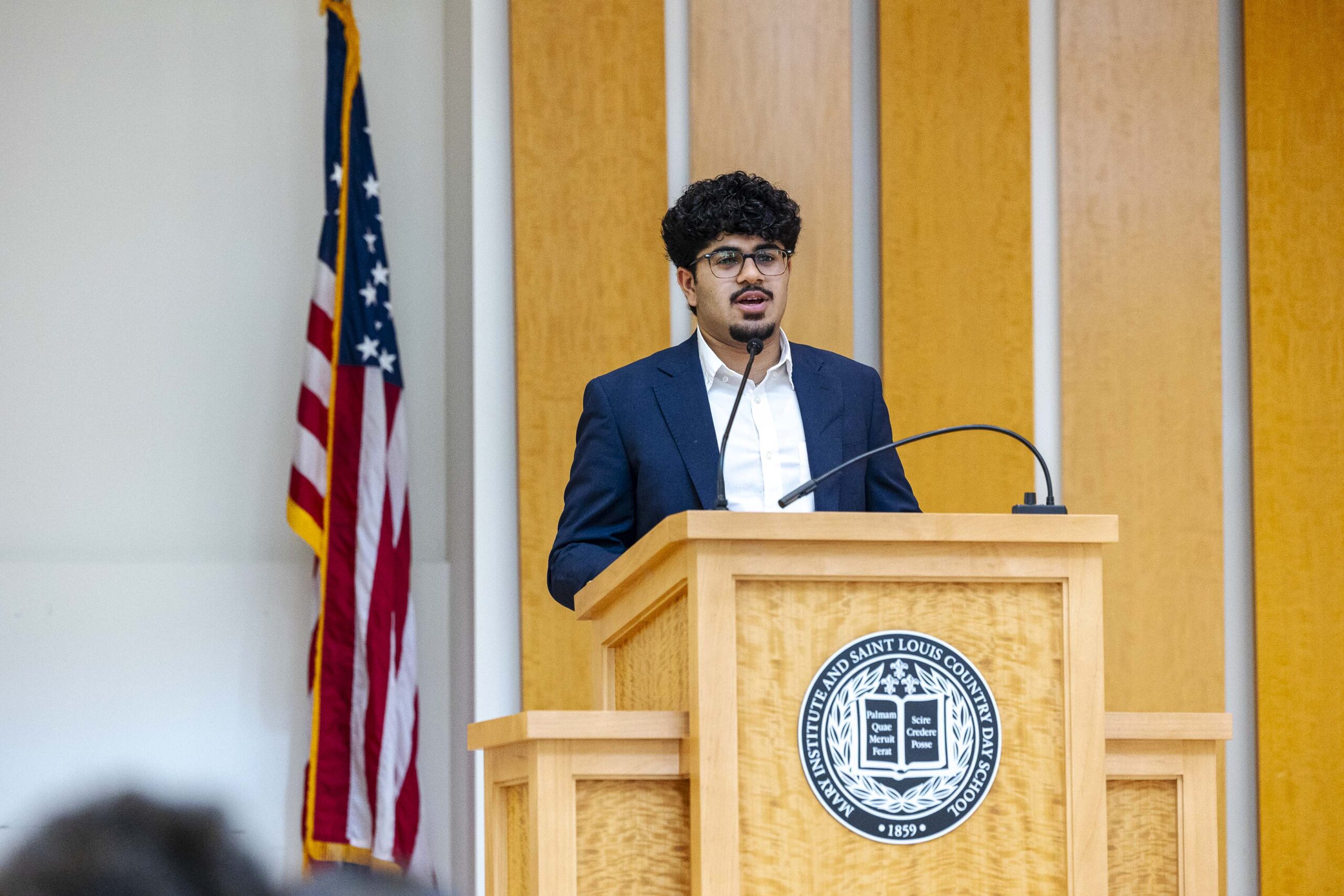
Nihaal Satwani ’26 on Finding Community at Cum Laude Ceremony
As part of the MICDS Cum Laude Society induction process, each student candidate shared one of their College Common App essays for review by the Cum Laude faculty members. The faculty selected several essays, which were shared at a special breakfast held for the student candidates. The students then selected Cade-Michael Miller ’26 and Nihaal Satwani ’26 to share their essays with the full Upper School student body during the ceremony on Tuesday, April 21, 2026. Please enjoy Nihaal’s essay below.
“Caseyville? Where’s that at?”
Immediately, I think of the sole ice cream shop–Dairy Haven–the faded print of the giant plastic menu and the constant hum of the building’s wavering generator. And I think of how remarkable the seemingly unremarkable town of Caseyville truly is to me, and yet as I tell someone where I’m from, for about the millionth time, I have to explain myself. People rarely know it by name.
“Wow! That must be quite a drive, man.”
 It is. About a 40-60 minute drive each way. I’ve become accustomed to the long hauls every morning and afternoon, but sometimes I have a difficult time accepting their ramifications – the isolation, the tediousness, the struggle. All my problems could magically be attributed to my physical distance from school. But my inability to attend the random hangouts or football games created an innate appreciation for the connections I had, and an intense desire to find connections wherever I could. Unusual Places. Old Places. New Places. I wasn’t just looking for friends: I sought places where curiosity could connect me with people who otherwise would remain strangers. I found myself walking back into my library–the one I had spent years visiting with my grandfather–only this time in search of a place, not a Big Nate book.
As luck would have it, the youth chess club needed an assistant. So I showed up on a bright and early Saturday morning, ready to help out. Since then, the club has continued to be my second playground, a constant in my life I can depend on. I remember parents walking in with their child with quiet warnings–”He’s shy,” or “She probably won’t talk much” – already half-apologizing before the game even began. Yet by the end of the game, they’d be laughing over the silly names I’d make for my pieces or my pretend anger at blundering another bishop; their parents looking over my shoulder as if I’d just pulled off a magic trick. Other times, kids would gather around my board as I’m about to lose to someone half my age, laughing (with me) as my pieces dwindle down.
I’ve found that what I love most about the chess club is not the chess game itself, but the person I sit across from. As peculiar as it may be, I think I’ve found a sense of community in a game traditionally played in silence.
 Maybe I’ve unknowingly become an example to this community. Kids watch how I treat the game–creatively and playfully–and hopefully realize that chess isn’t a dry strategy game for an older generation. Parents sometimes compliment me afterward about my teaching strategies and request I make the club more frequent. I don’t have a pile of chess awards or titles to display in my room (unless you count “Record Losses to Kids Under 10”), but I still have many beloved keepsakes: the homemade honey from one family, the Chick-Fil-A gift card from another, and the multitude of thank-you letters handwritten by my mini-friends. Perhaps I’m really making an impact: these gifts weren’t just keepsakes, but evidence that joy and curiosity can spread in a manner unmeasurable by a gleaming trophy. Or maybe I’m just a goofball playing chess at the library. Either way, I’ll take it.
“How do you survive being that far away from everything?”
I peer inside the chess room, remarking the gleeful shouts, constant chatter and buzz surrounding the chess boards. I realize now that the distance doesn’t matter so much, only what I make of it–the connections, the playfulness, and the curiosity. I hope to maintain that sort of energy wherever I go. And if that space doesn’t yet exist, I’m now positive I’ll find a way to create it. I’ve learned that building a community is less about proximity and more about imagination, following my own curiosity until something new emerges, something that otherwise wouldn’t be there.